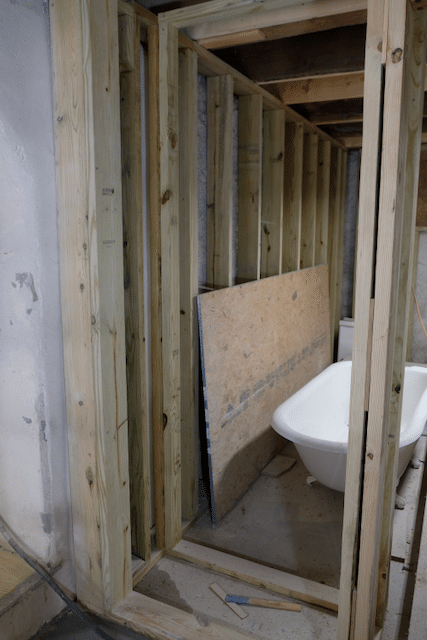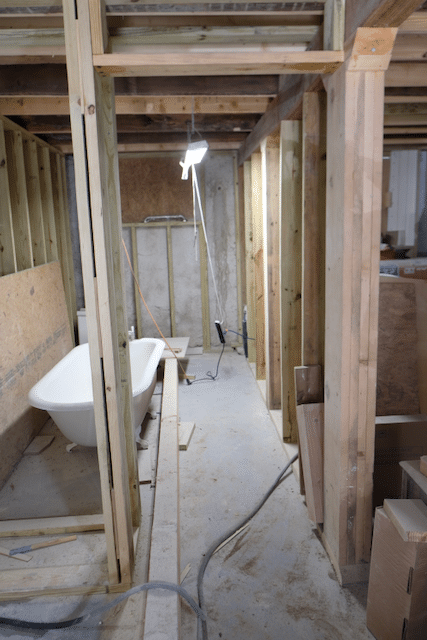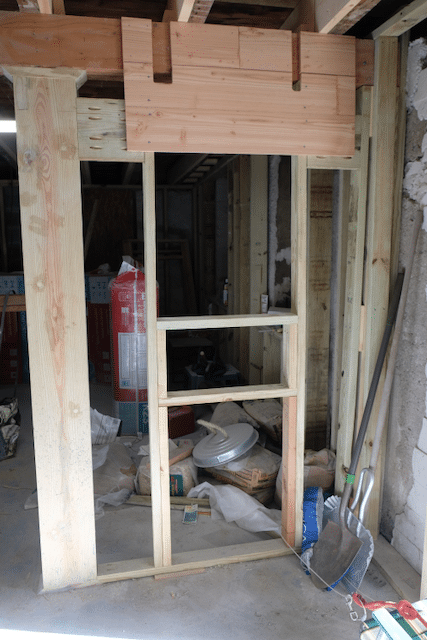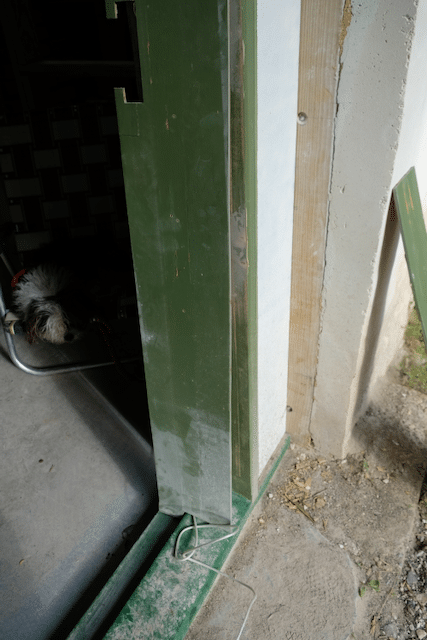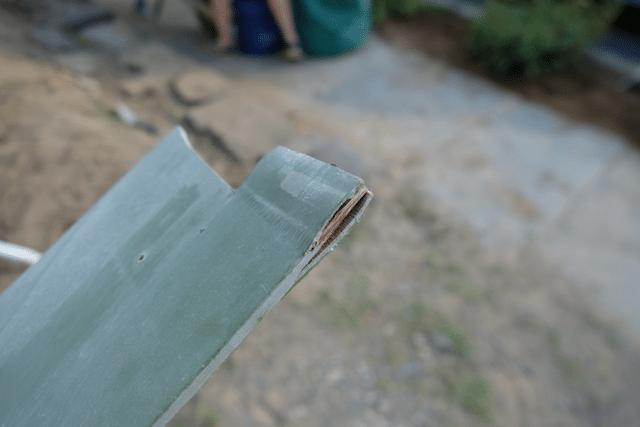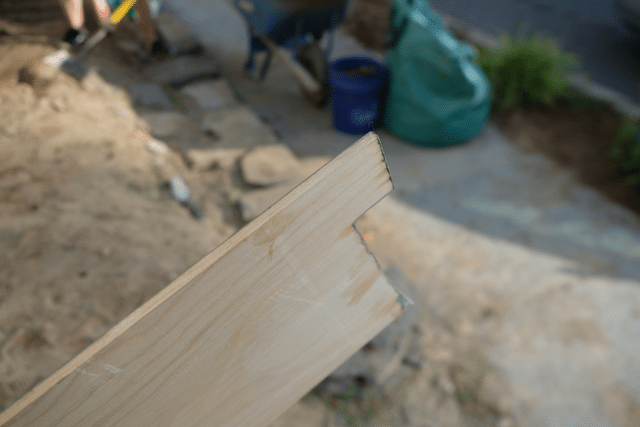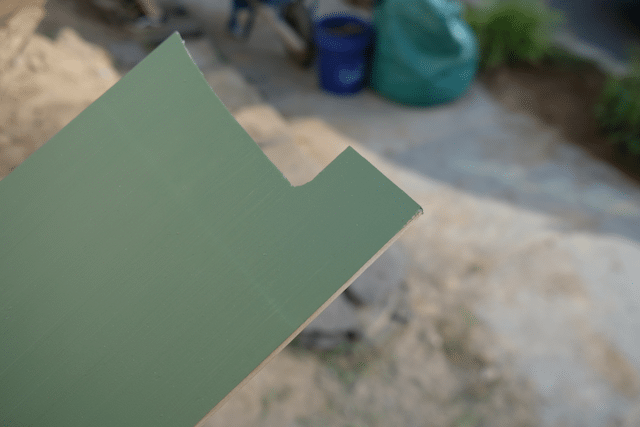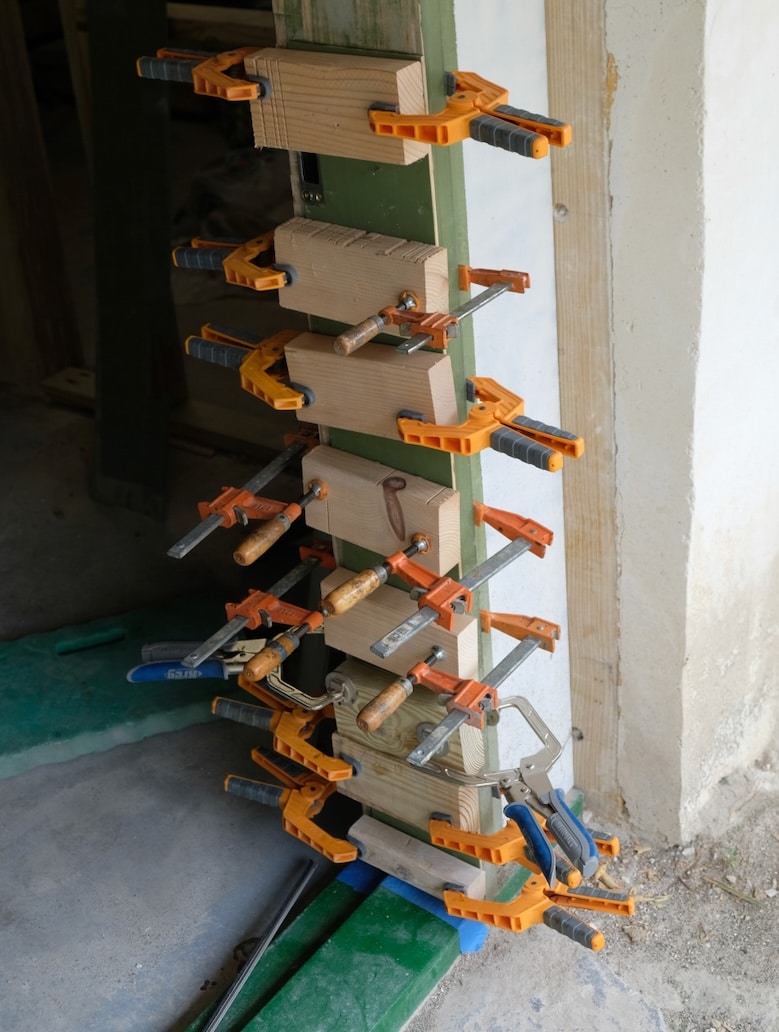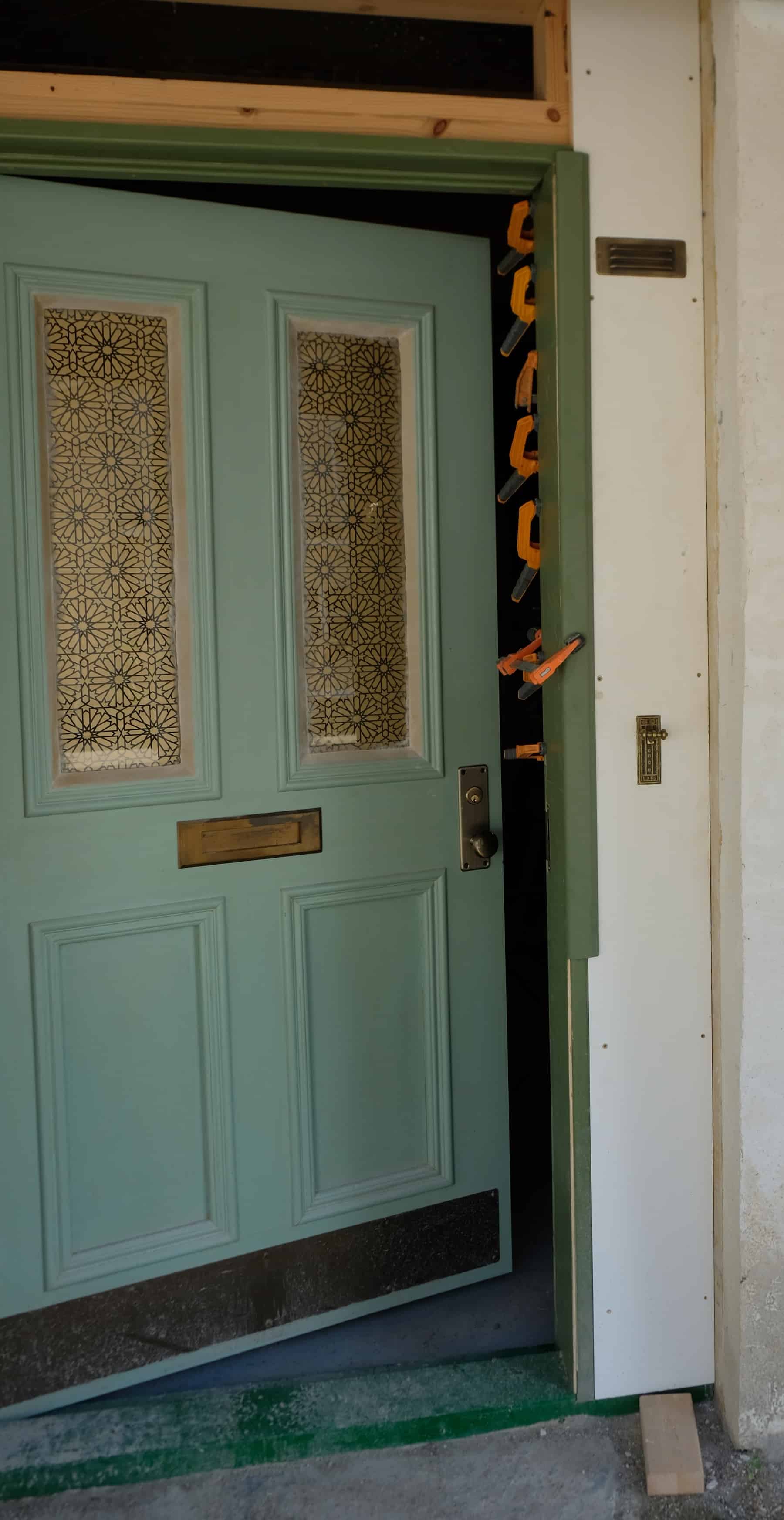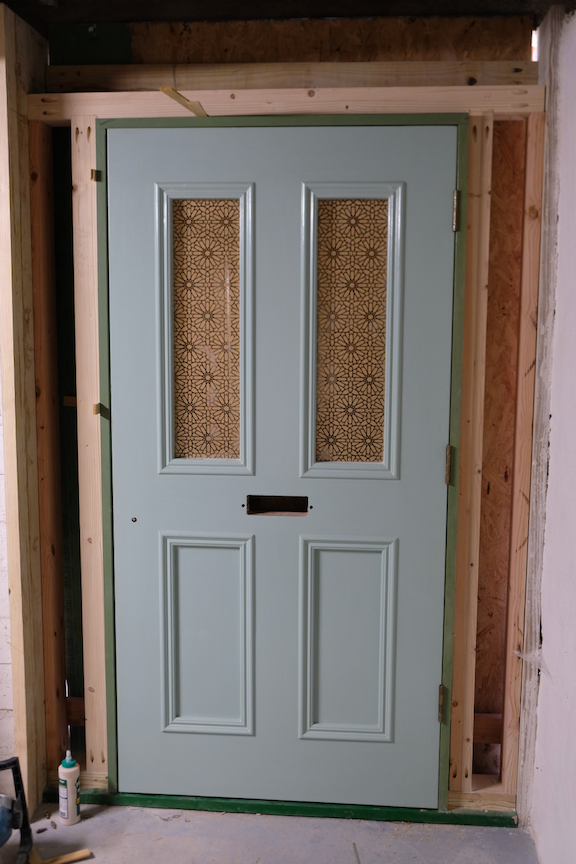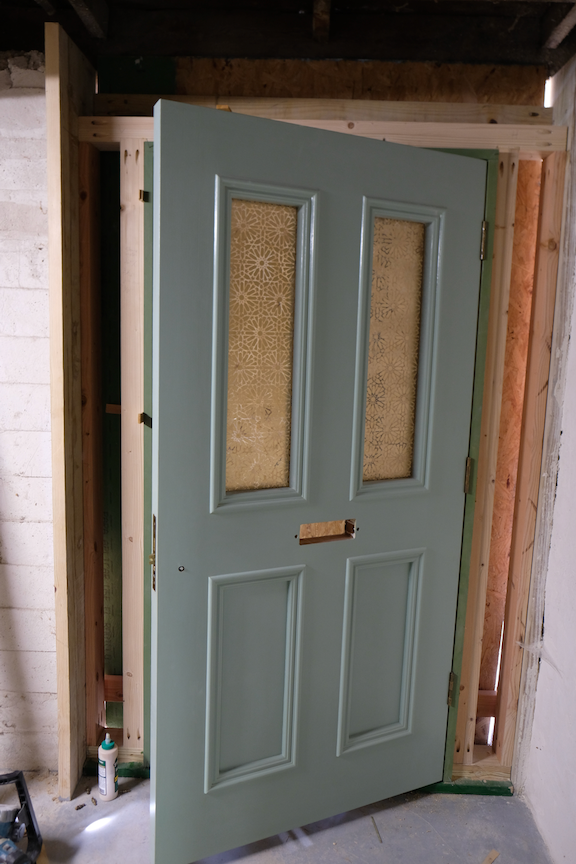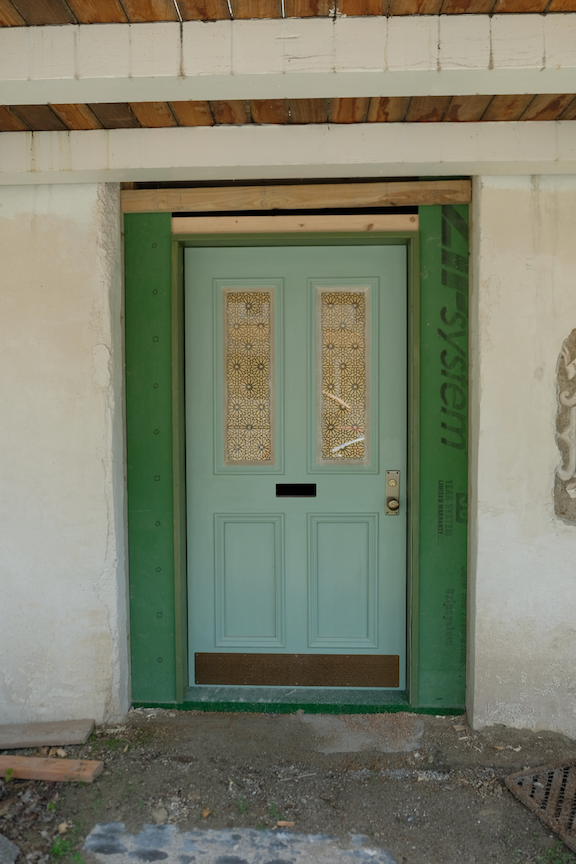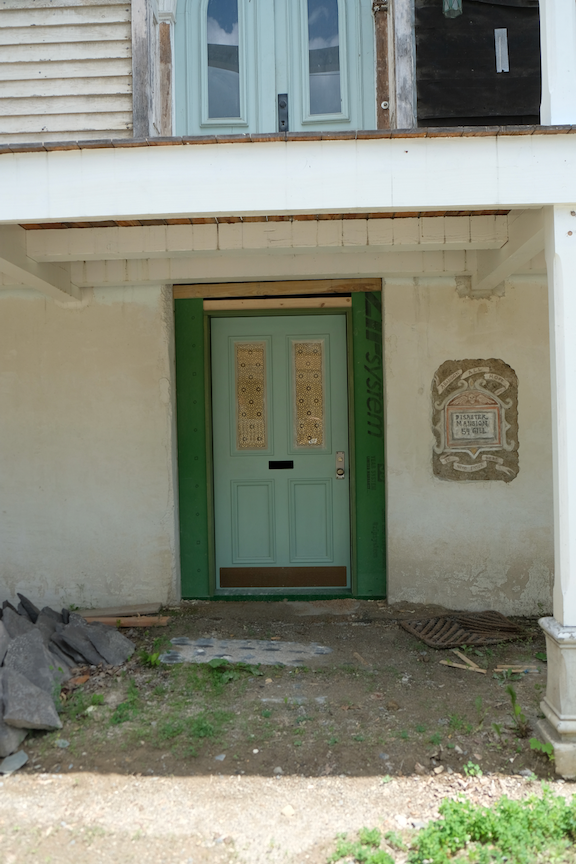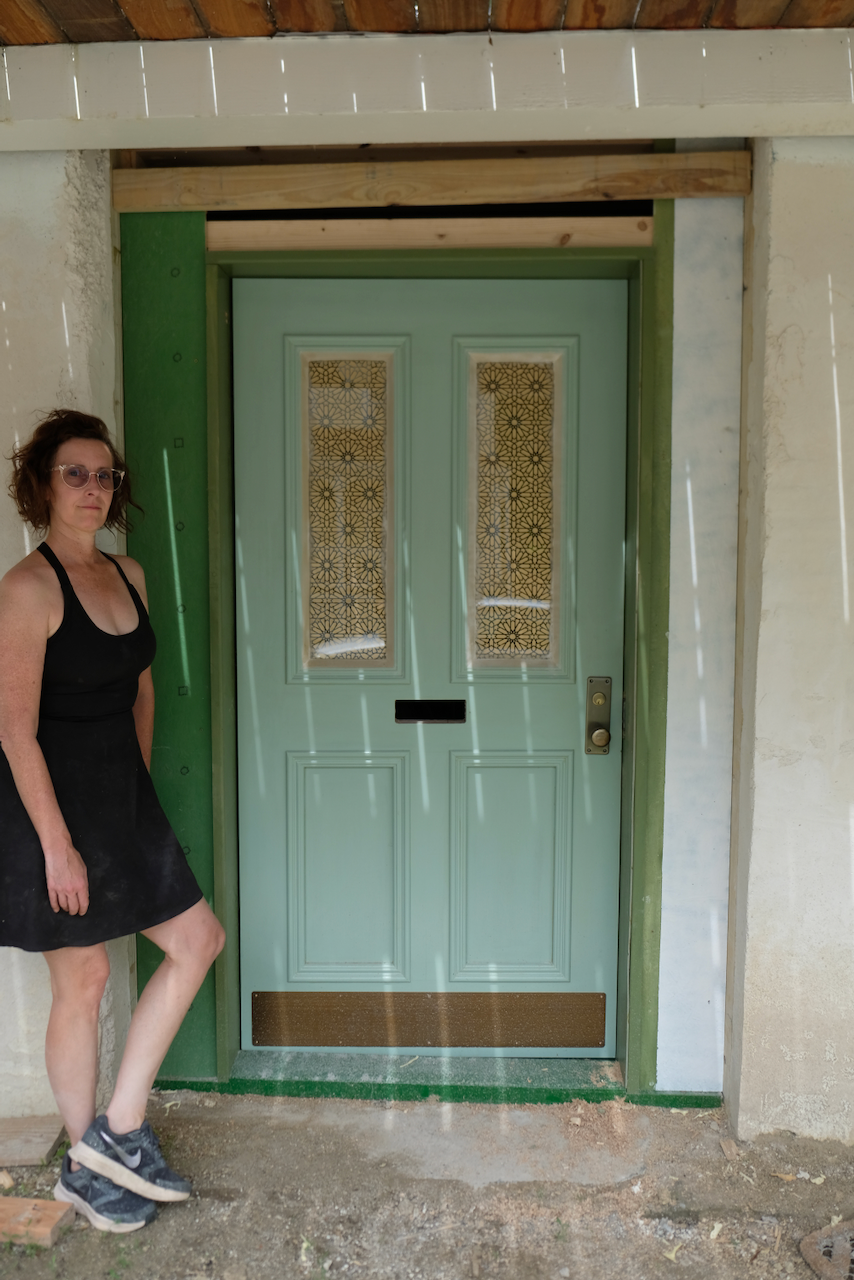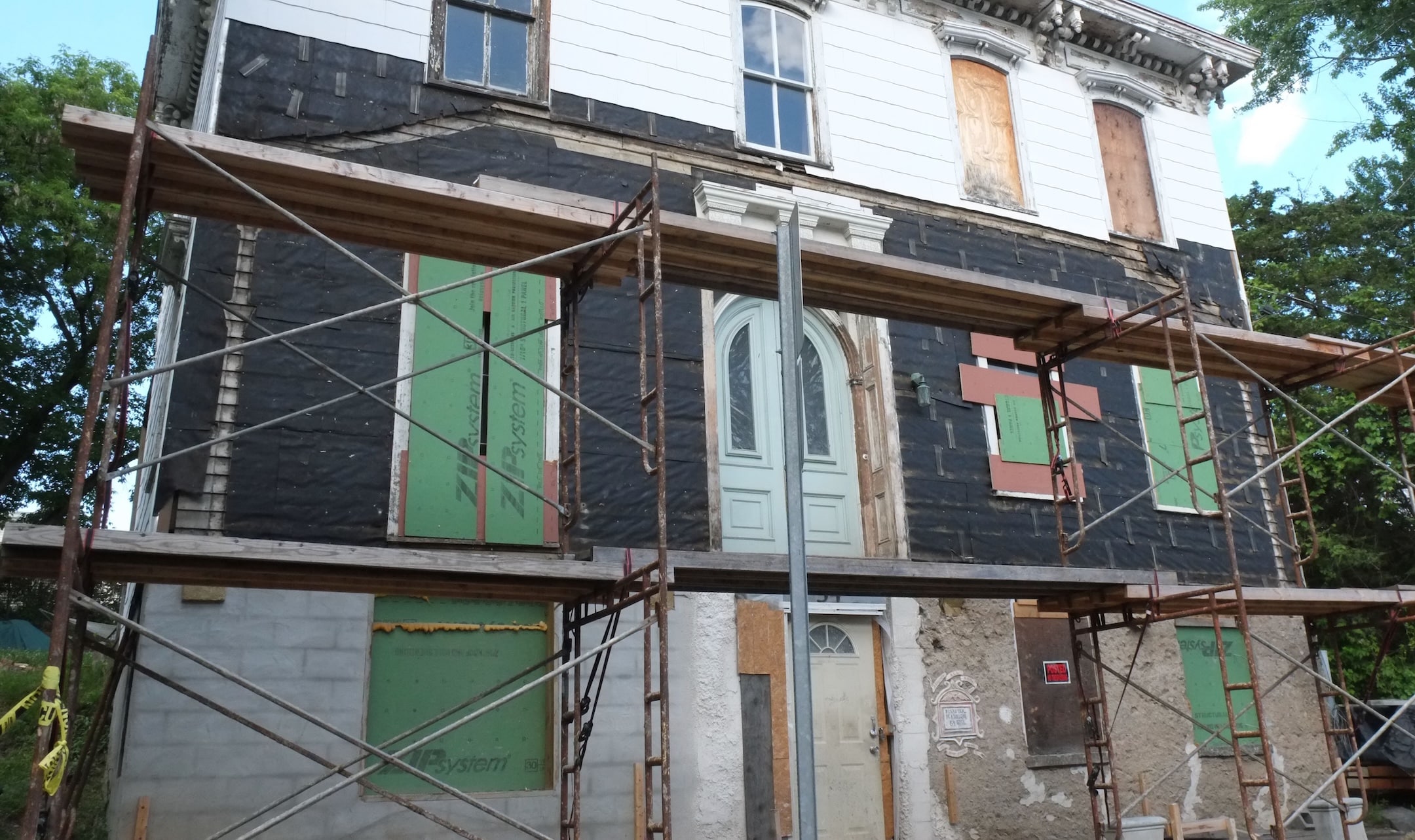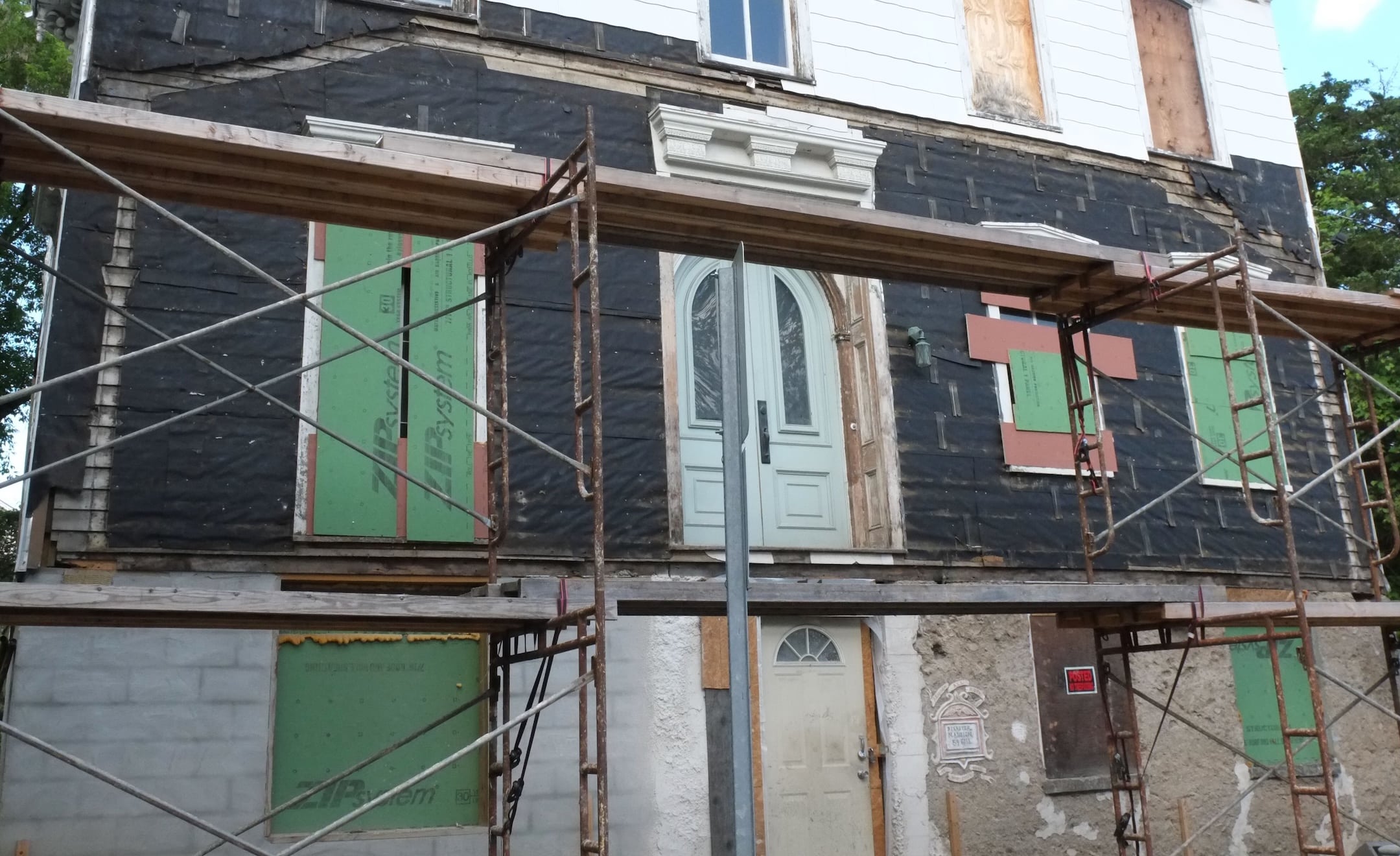
It’s a new dawn. It’s a new door, and we’re feeling good …

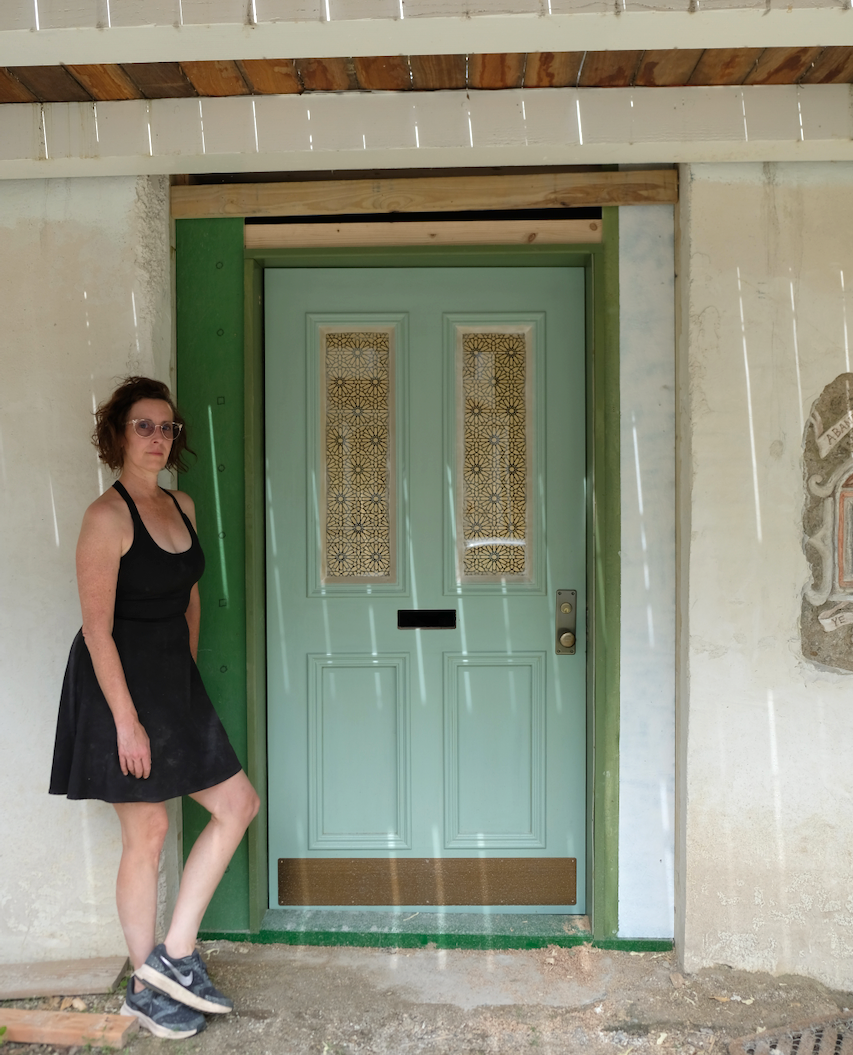
Finally, we have our front door back. No more climbing up and down a ladder thirty times a day. I can’t believe that we made the door six years ago, where did the time go?

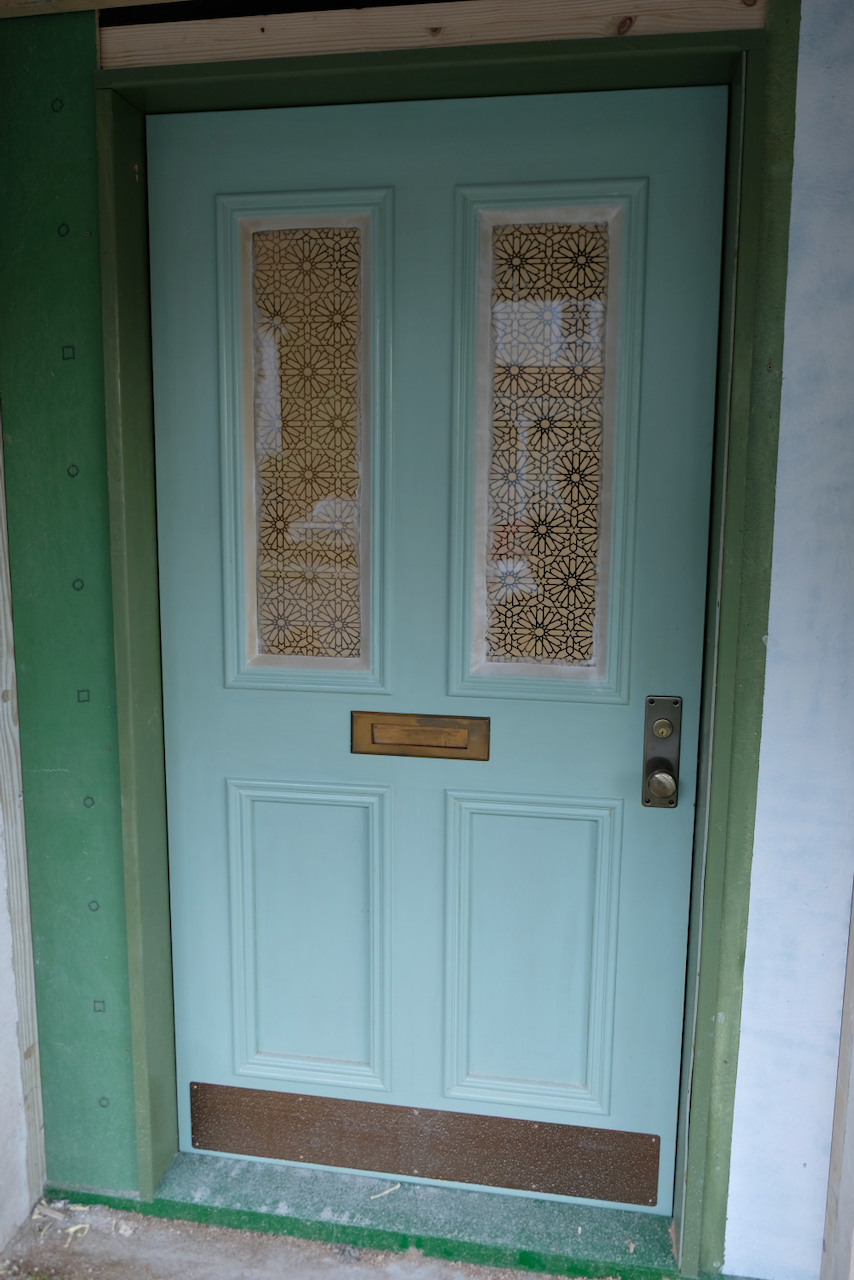
It’s a pretty thick and hefty door, but very sturdy, made mostly from locally sourced red oak; it also includes some wood from what we think was the original downstairs front door. Maybe that makes it a restoration, rather than a new door?

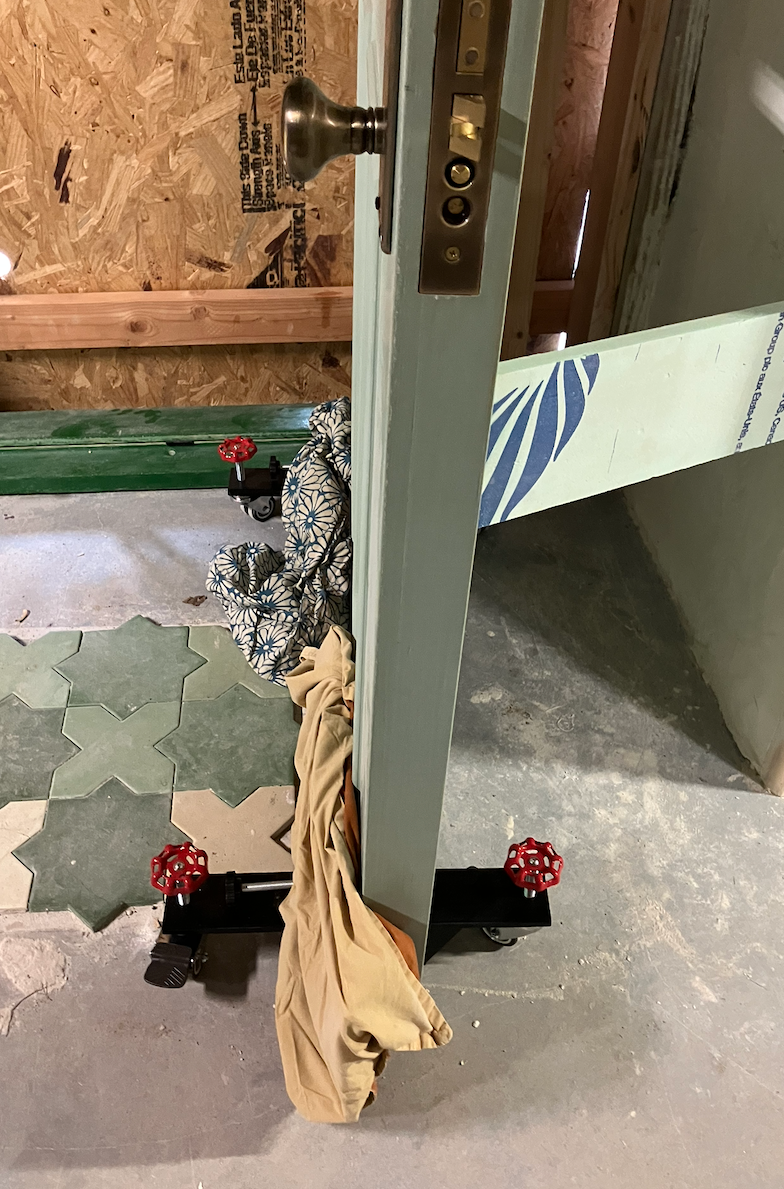
I wasn’t sure how we were going to get it downstairs without damaging it, and there was no way we could slide it down the ladder. In the end, we used a panel dolly, which, with Joe’s help, we managed to move it without any damage.

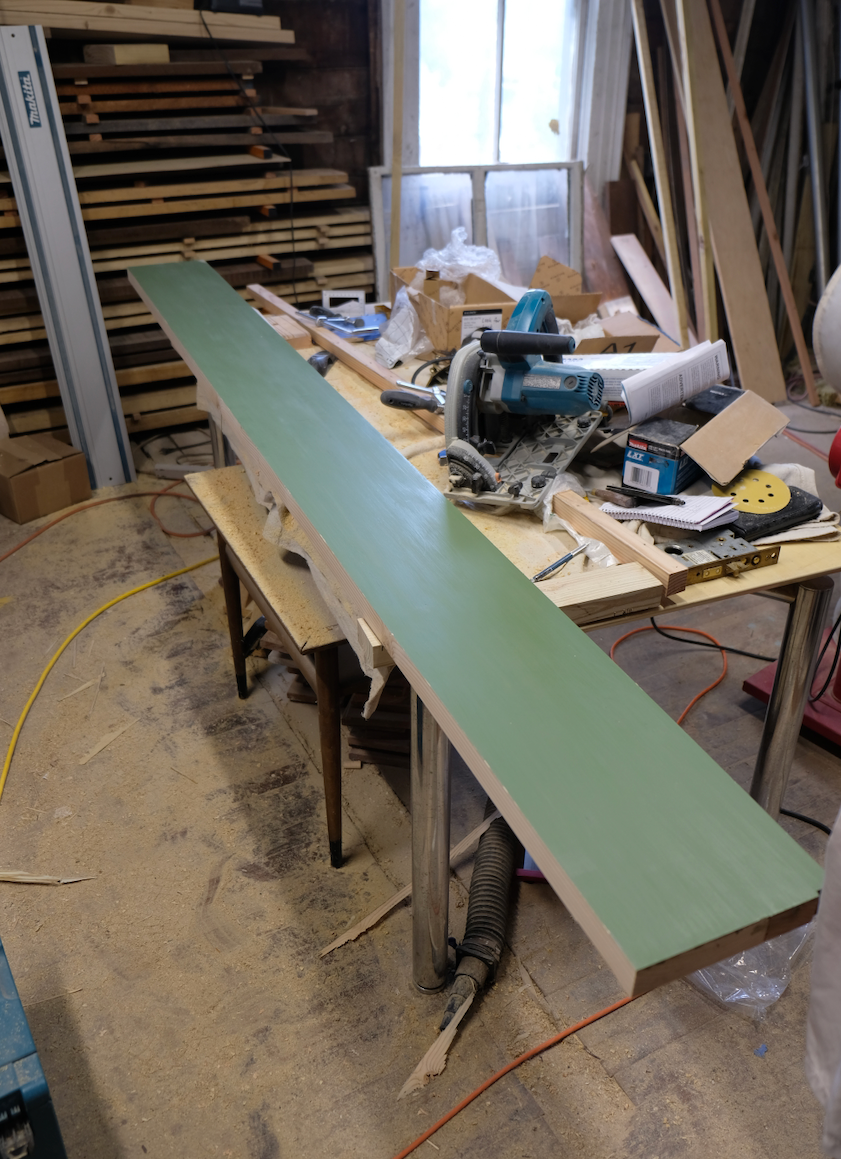
Once inside, the first job was to glaze the windows. Glazing isn’t my finest skill, though I am getting better, and it seemed easier to glaze when the door was flat. That done, we had the task of hanging it, and what a nightmare that turned out to be. Did I mention that the door is heavy? Not sure how much it weighs, but it’s probably north of 70 lbs. When you watch videos of people hanging doors, they always seem to be lightweight doors that a person can hold in one hand while screwing in the hinges with the other, not so in this case.

What saved us was this door dolly. It’s amazing what products you find when you need them. With this, we could adjust the height so the hinges pretty much lined up. As the door was heavy, it was difficult to keep it vertical, but with various wedges, we got it close. Then the fun started.

First, the door wouldn’t close because the hinges were too far into the door frame, so the door came off. Holes were glued and dowelled, and new hinge recesses were chiseled out. Once I got the door to close, it was fine except for the top right corner, which was sticking out 1/2″. Was the door warped? I was really hoping it wasn’t, as I didn’t want to make a new one.

A day later, I checked the door for warps, and luckily, it was pretty straight with any deviation less than 1/16″. Then I checked the door frame, which was also less than 1/16″ off. Armed with that, the door should fit, so I went about moving the hinges, possibly another ten times, each time gluing and dowelling the old holes. Without the door dolly, I may have given up. In the end, I got the fit to be within +/- 1/16″, which is good enough for me. Next time I make a door, it won’t be so heavy, lesson learned.

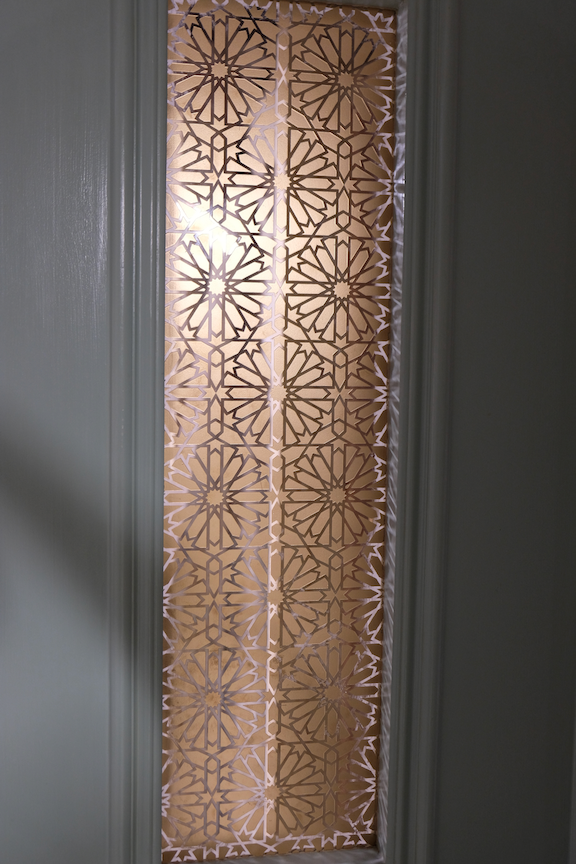
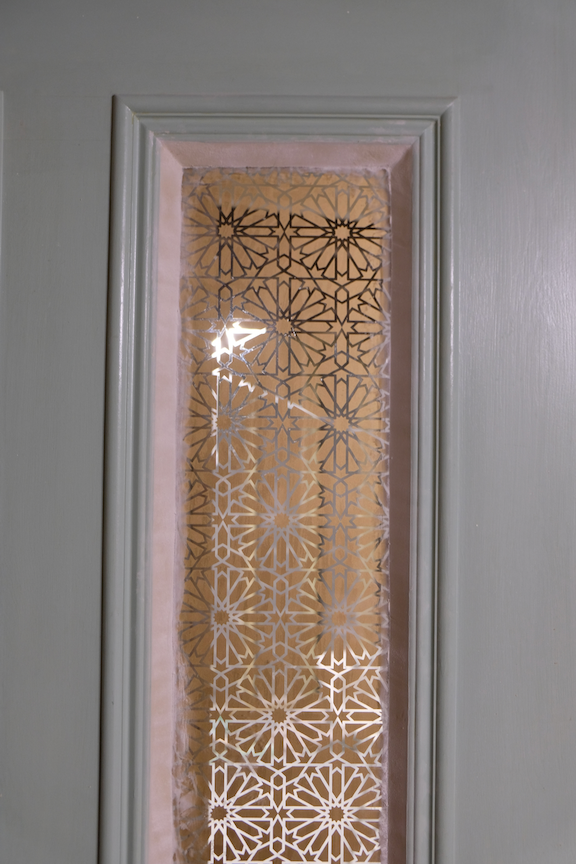
The design on the panes is Moroccan. We used a Cricut vinyl cutter to cut the design, and after applying it, we acid-etched the glass to give the gold paint a better surface to bond to. Overall, we’re very pleased with how it turned out. Thank you, Susan, for your Cricut expertise 🙂

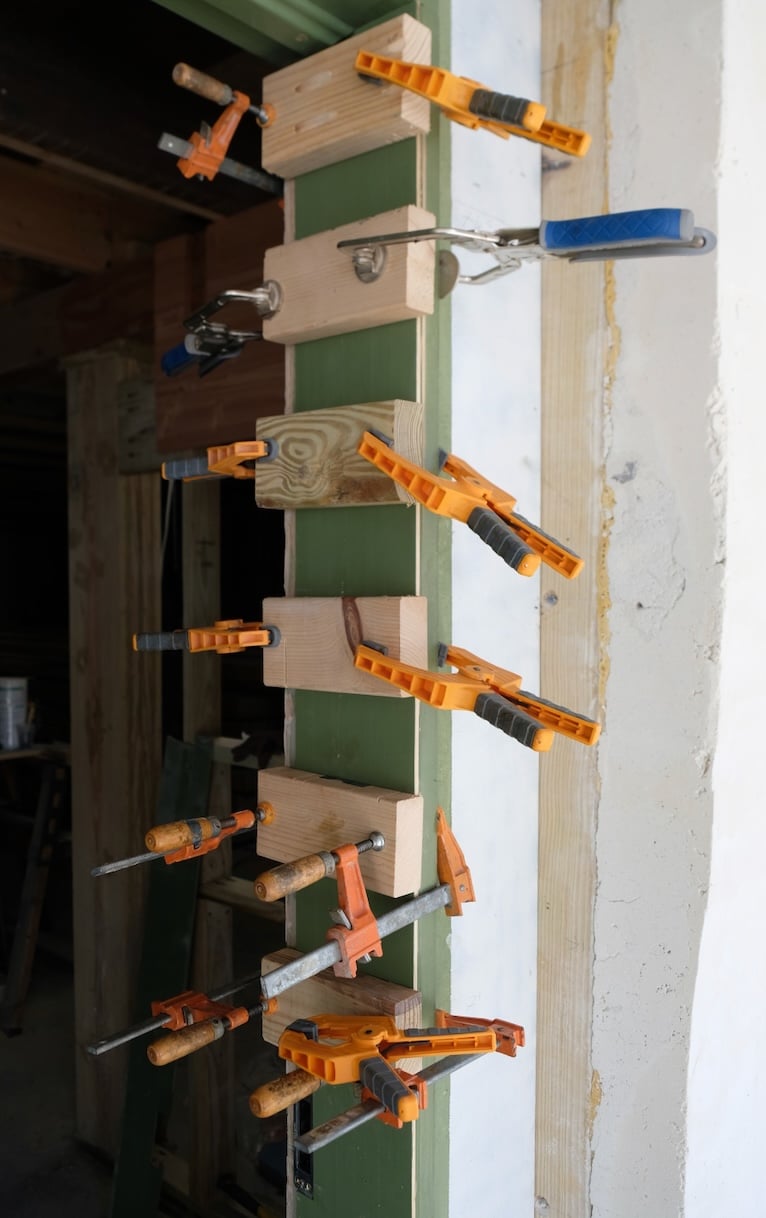
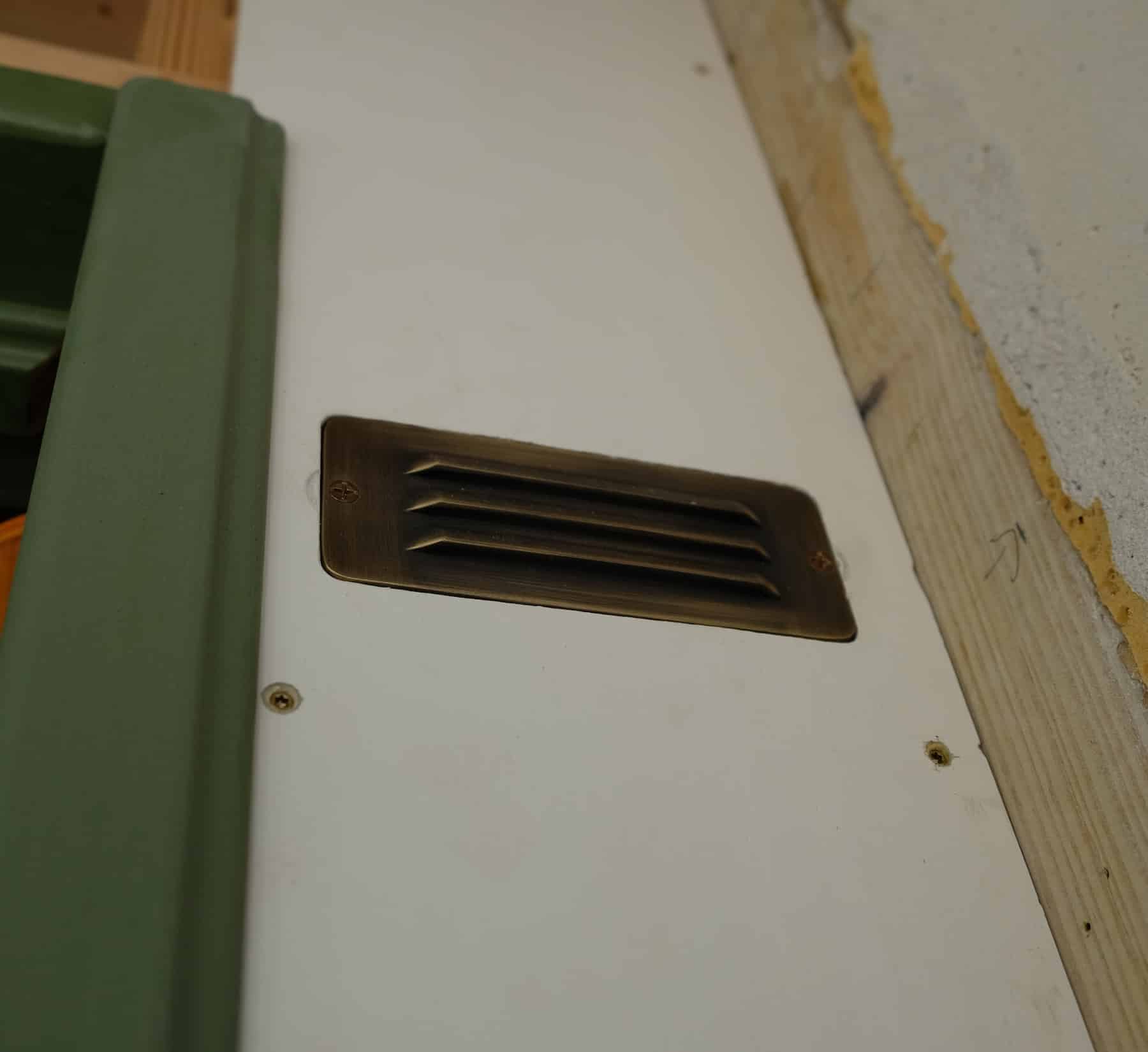
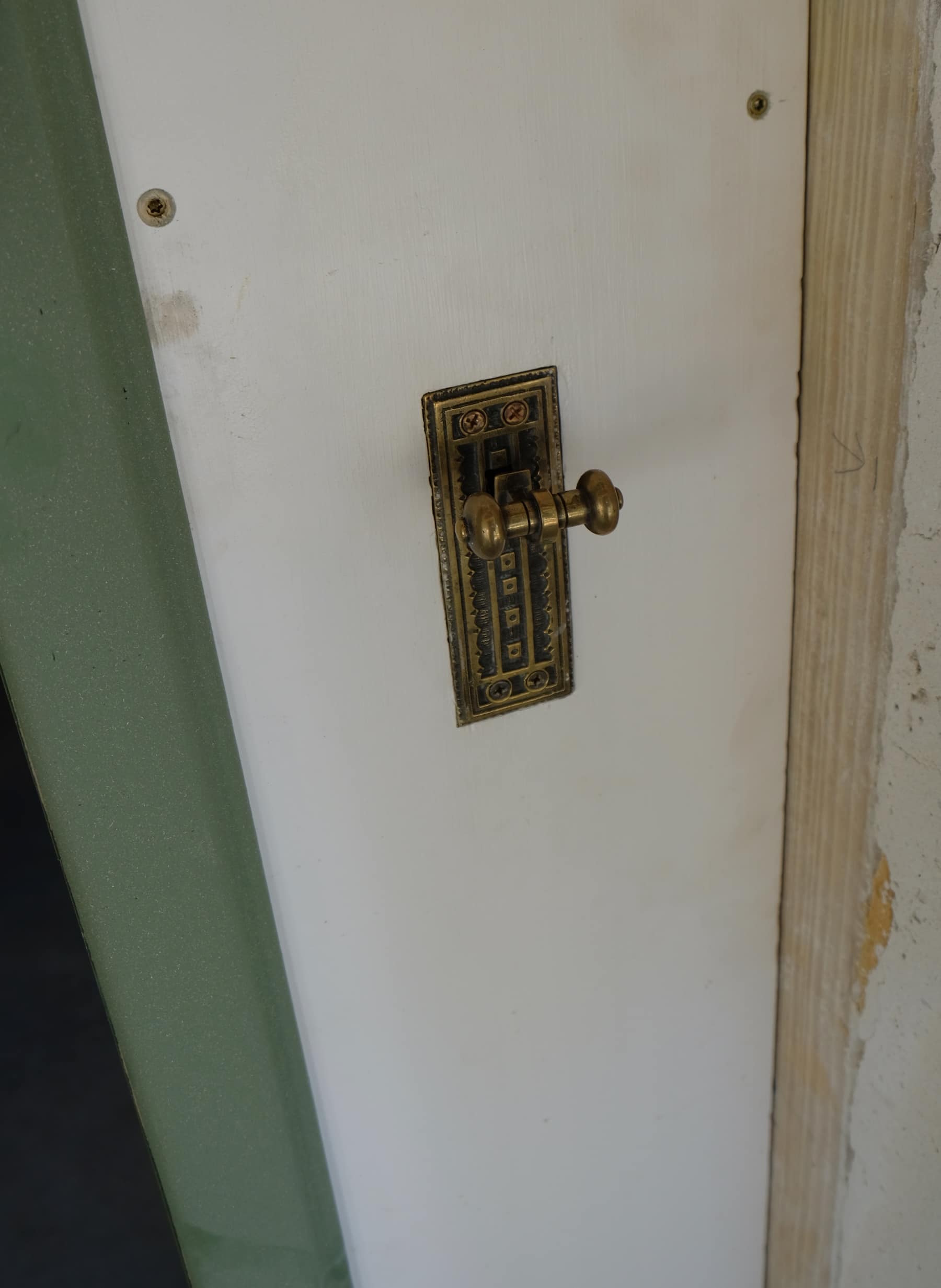
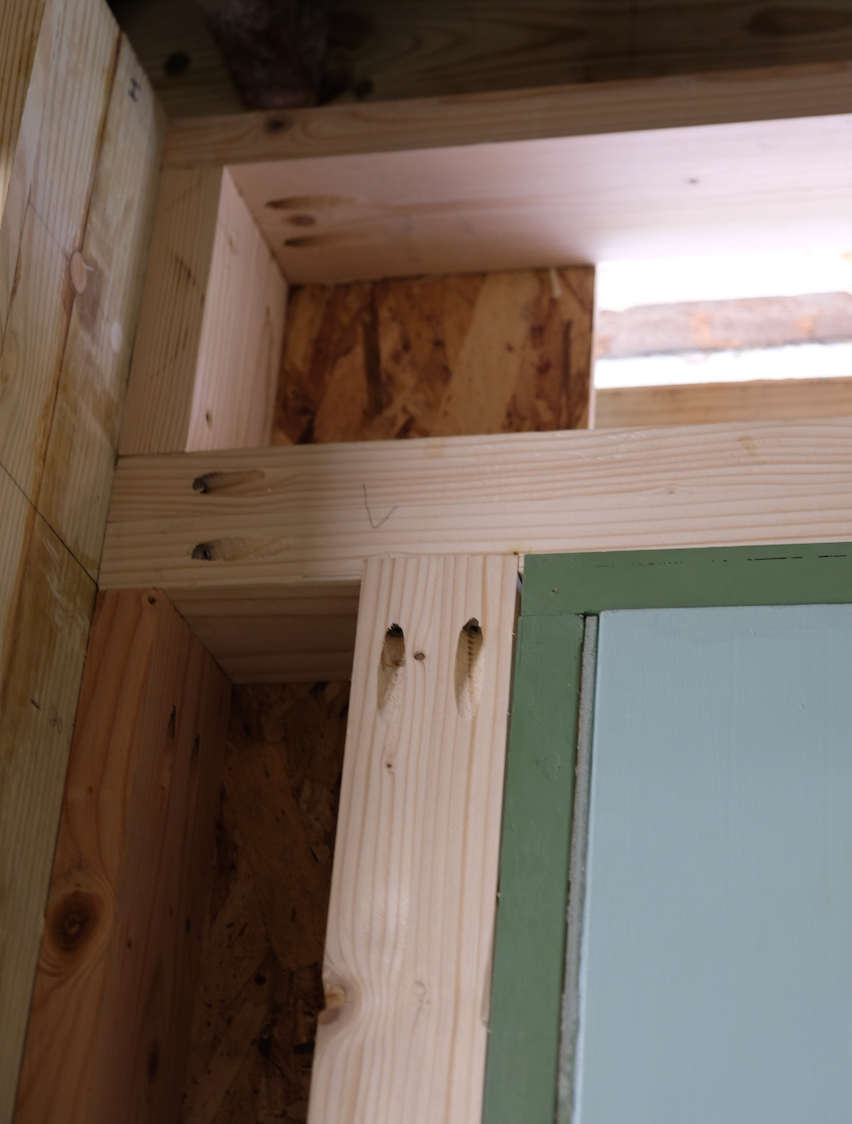
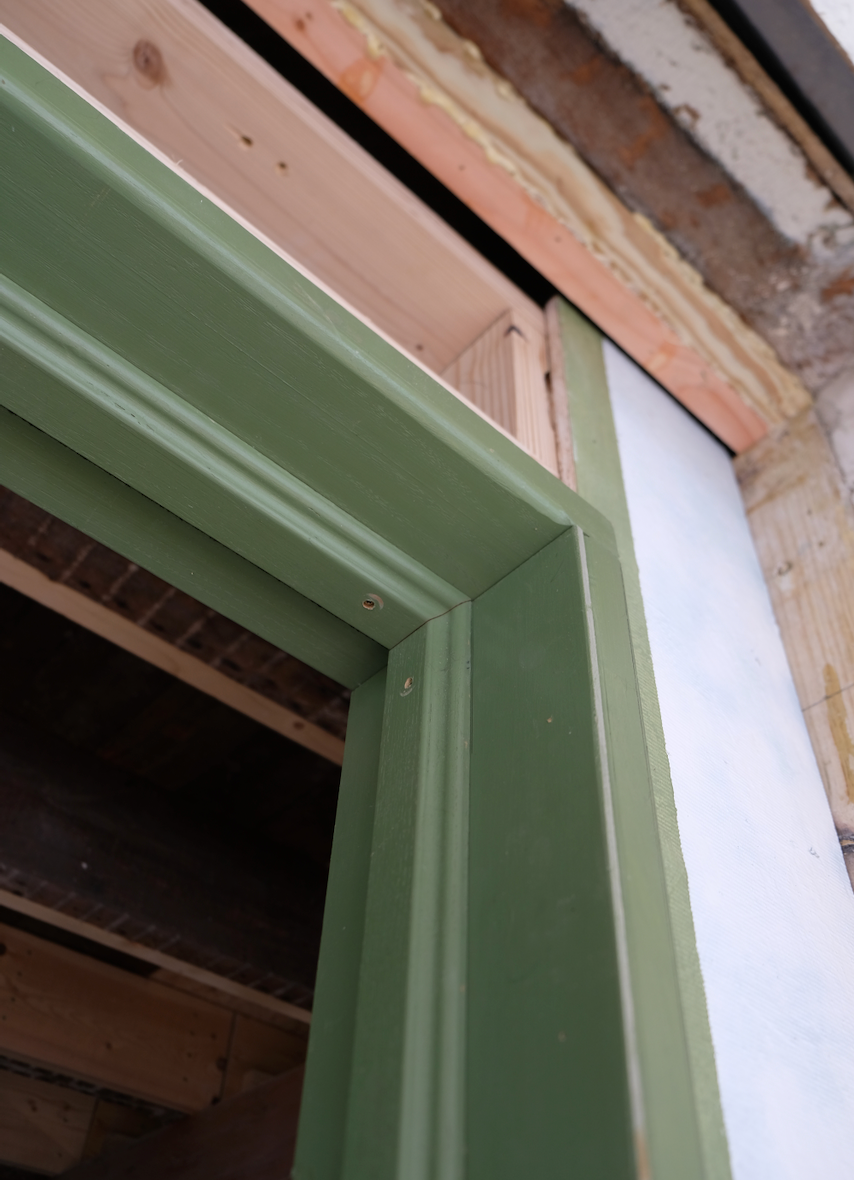
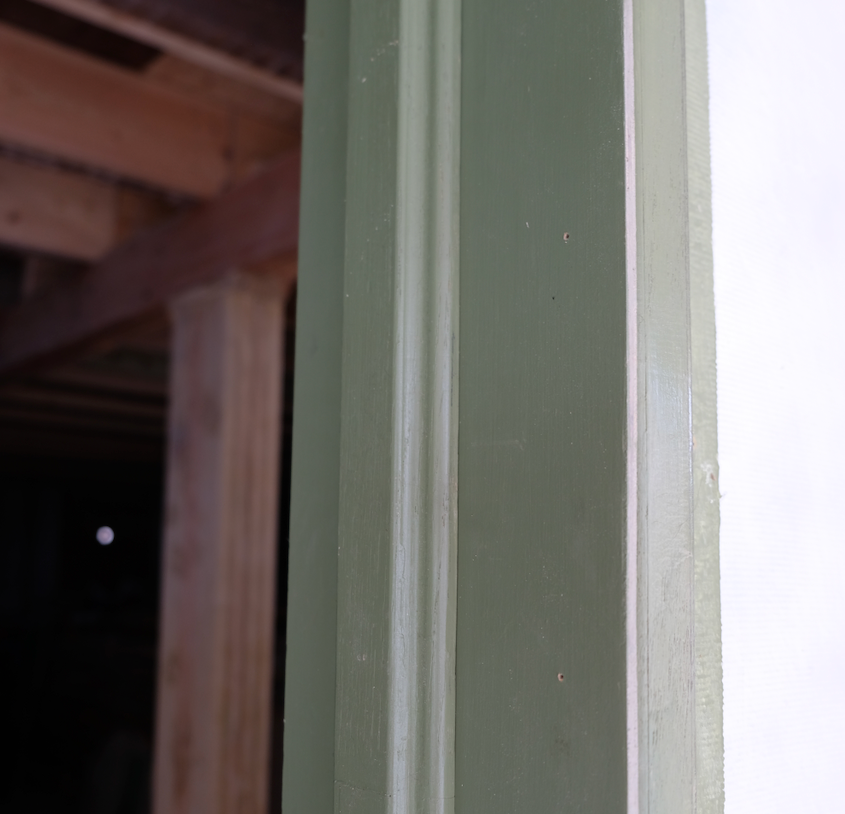
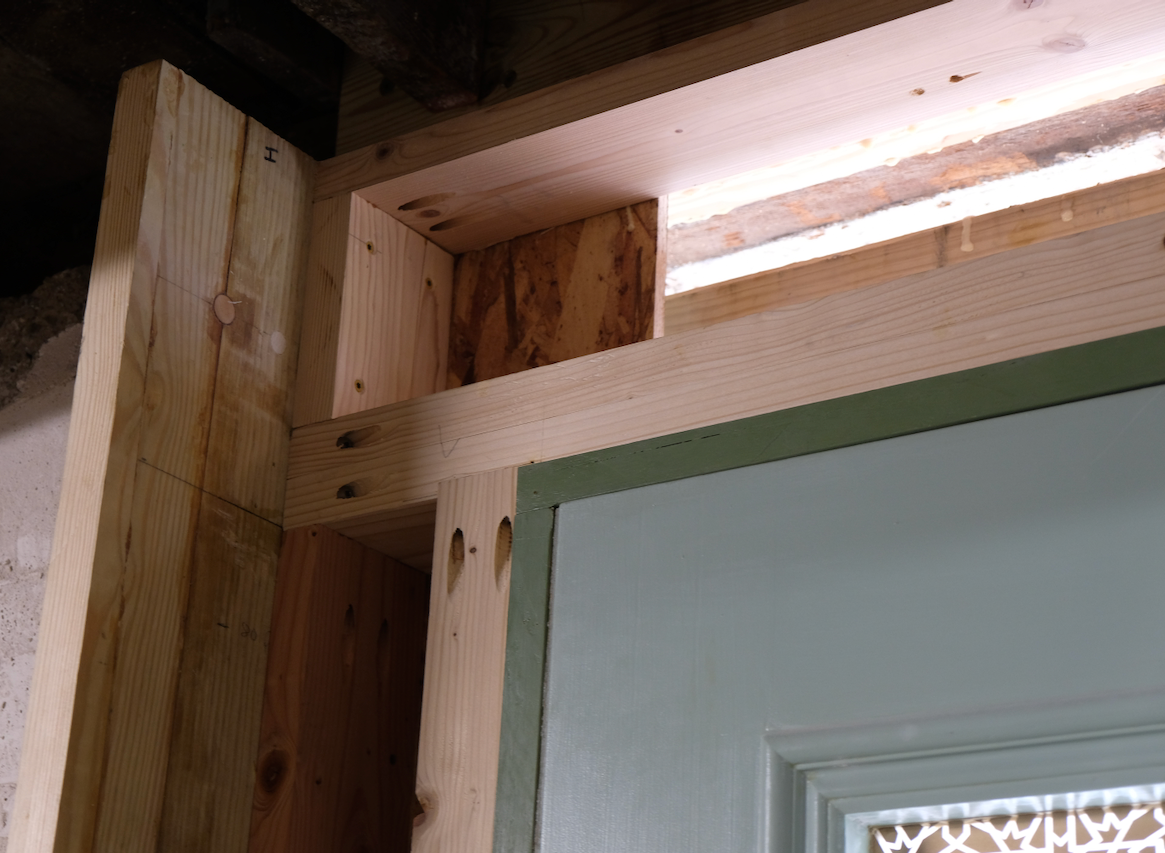
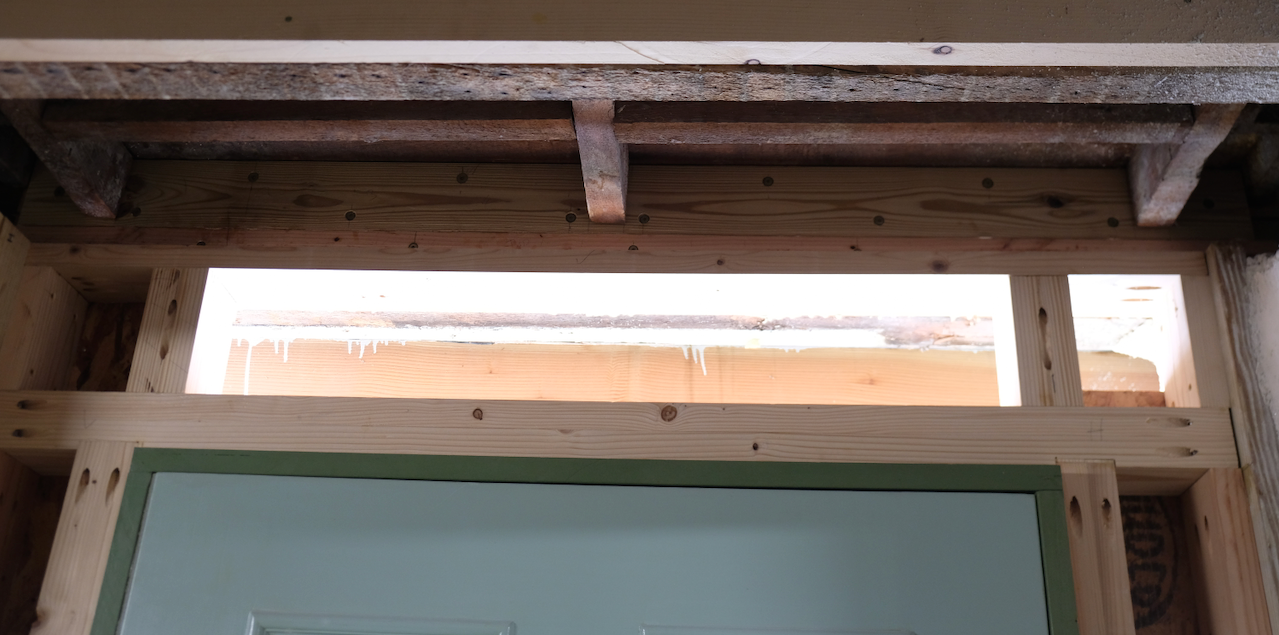
Still a bit of work to do on the entrance way. The letterbox and some of the trim have been installed, but quite a bit of trim still needs to be made, and I also need to paint the glazing putty. You’ll notice that I use Kreg pocket screws for the framing, which seems easier than trying to plant a couple of nails accurately, plus I can undo stuff if I make a mistake, which I’ve needed to do before. The screws take longer, but that’s how I roll.

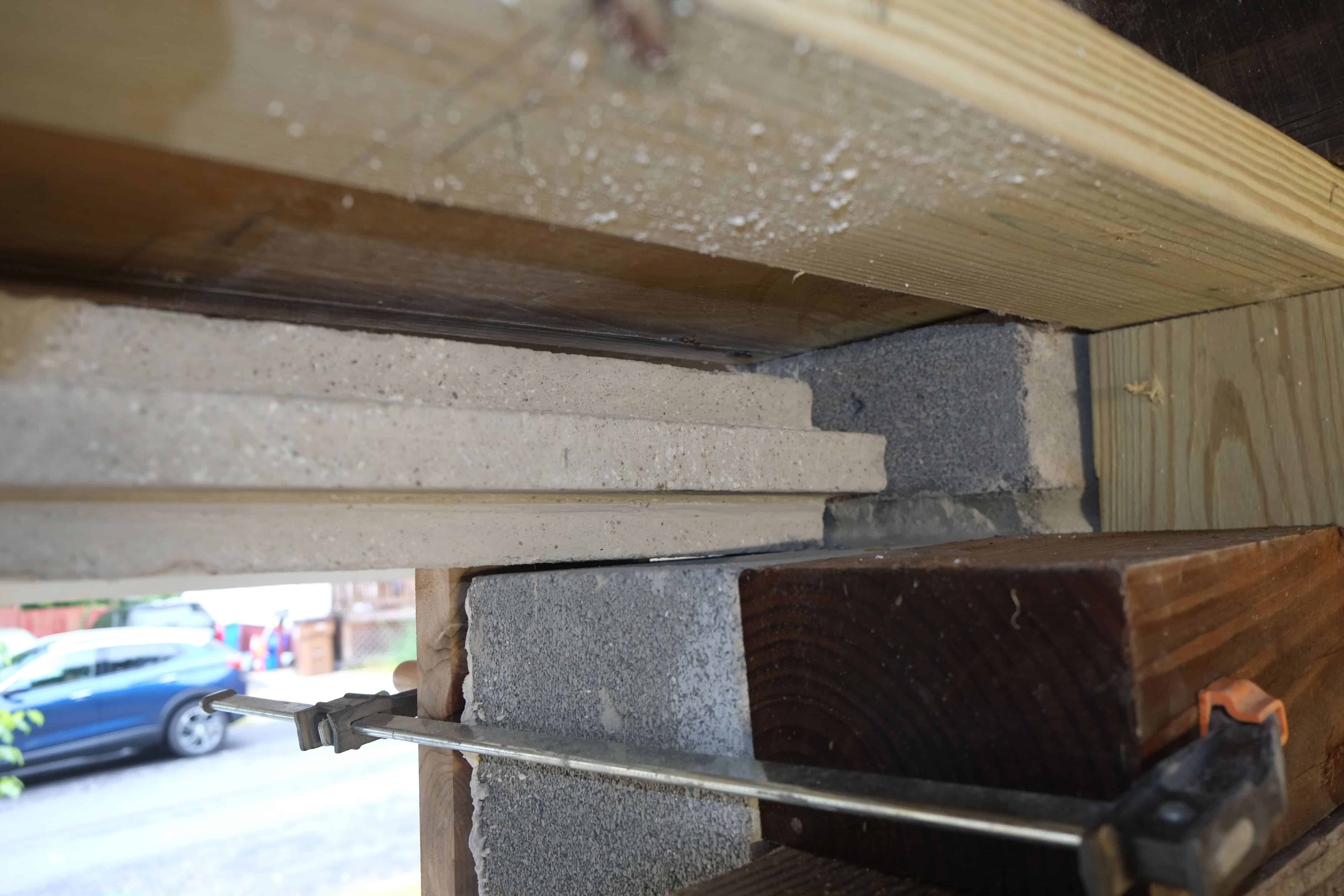
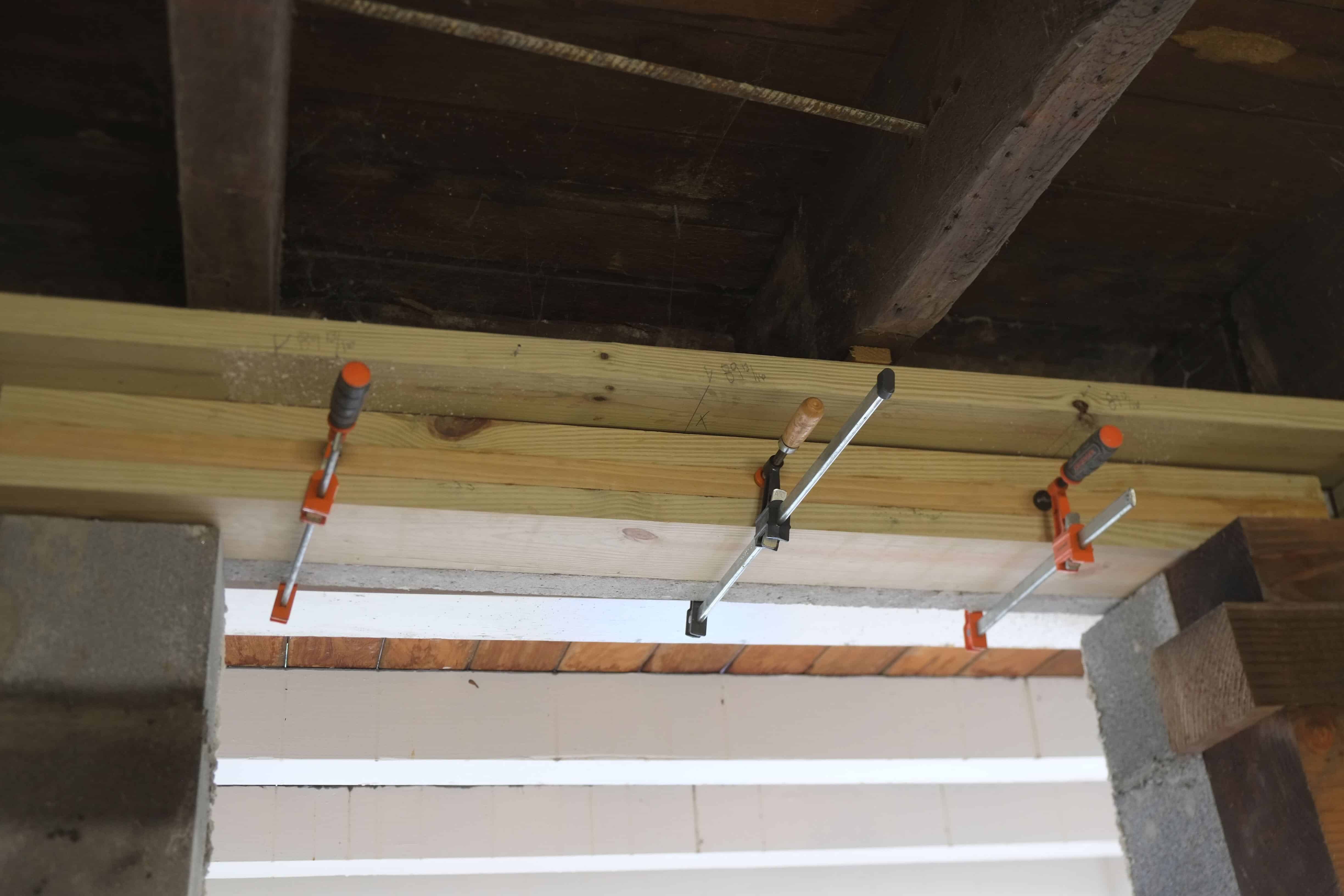
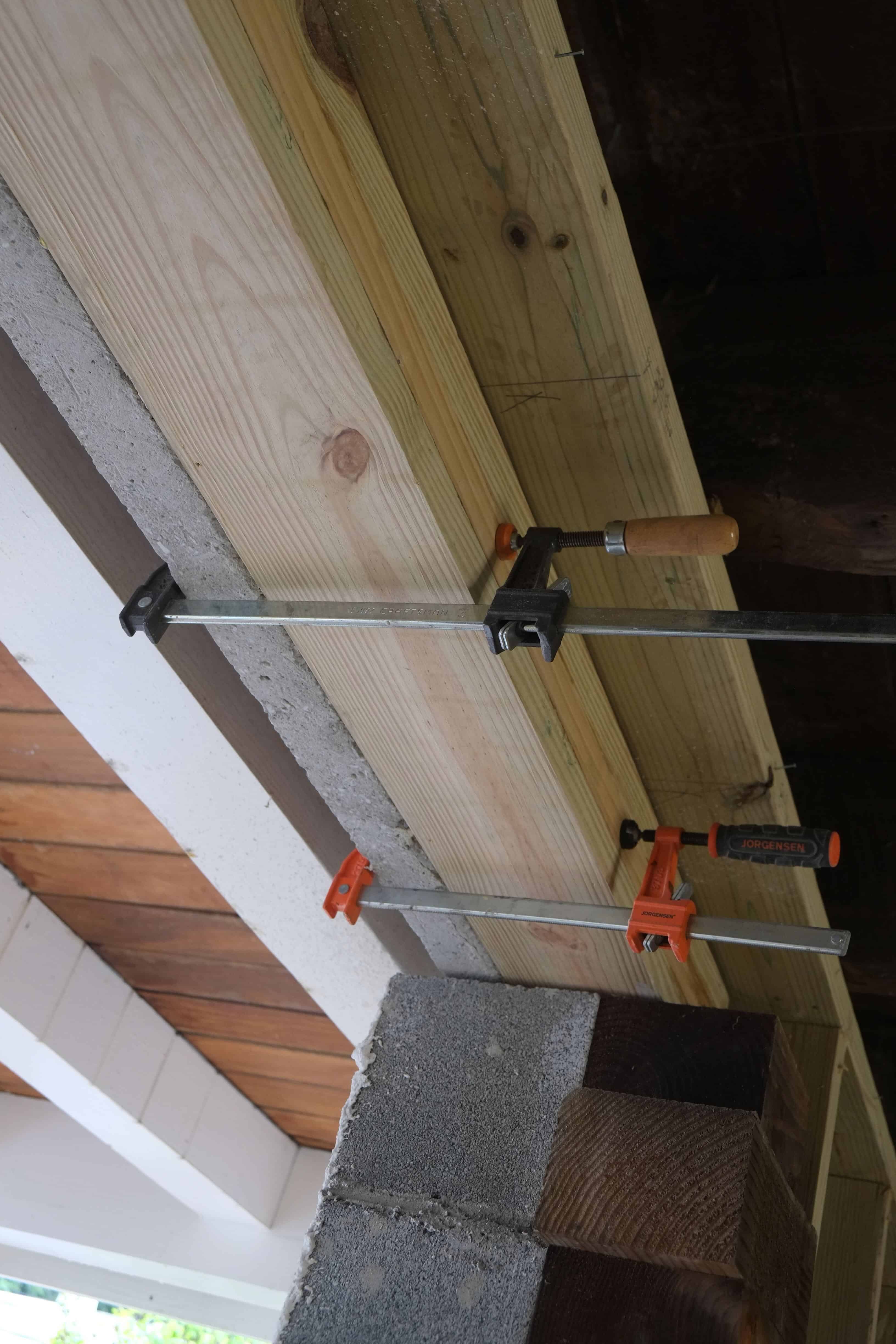
Probably not clear from the second photo, but I did sister two 2×8’s onto the original header beam that goes over the front door. This should make that beam pretty beefy, and when that area gets closed up, it shouldn’t need any attention for many, many decades.

We’re back!

Sorry for the lack of progress reports throughout 2025 and early 2026. My day job was brutal, and I was in a bad way healthwise for a lot of 2025, which I put down in part to my day job.

I’m not strictly a religious person, probably more spiritual, but in this matter, I’d love to think this was a divine intervention. A few weeks ago, I was laid off as part of a “reduction in workforce” program. I’ve been on the verge of quitting for a while now, and subconsciously I’ve been “slow quitting” for some time. That said, it was a shock to get laid off, and for the first week I did feel a little unanchored; in the second week, however, I felt a weight lift off my shoulders and was a lot happier. Third week, this is the best that could have happened to me. Thank you!!

I’ll miss the team, so a big thank you to Lonnie, Prateek, Dipanshu, Yogesh, Parveen, Swatantra, Siow Ting, and Wai Peng. I hope I haven’t forgotten anyone. I wish you the best and hope to see some of you in India next year.

Over the last few months, we’ve been slowly working on framing out the front door. We got some lovely local oak from John Paul, and I’ve been slowly constructing and painting the pieces at our apartment. We use linseed oil paint, which takes a long time to cure, but we’ve sped this up with some UV LED lights. More on the door in a future post.

I’ve also been working on tidying up the workspace at DM. For the last few years, we’ve been trying to crank out projects with little regard for workplace ergonomics, and it got to the point where you pretty much had to climb over “stuff” to get from one part of our workshop to the other. It took me about a week to sort things out, and now you can pretty much access all areas of the shop. I did take before-and-after shots, but I can’t find the before shots, so there’s no point in showing the after shots.

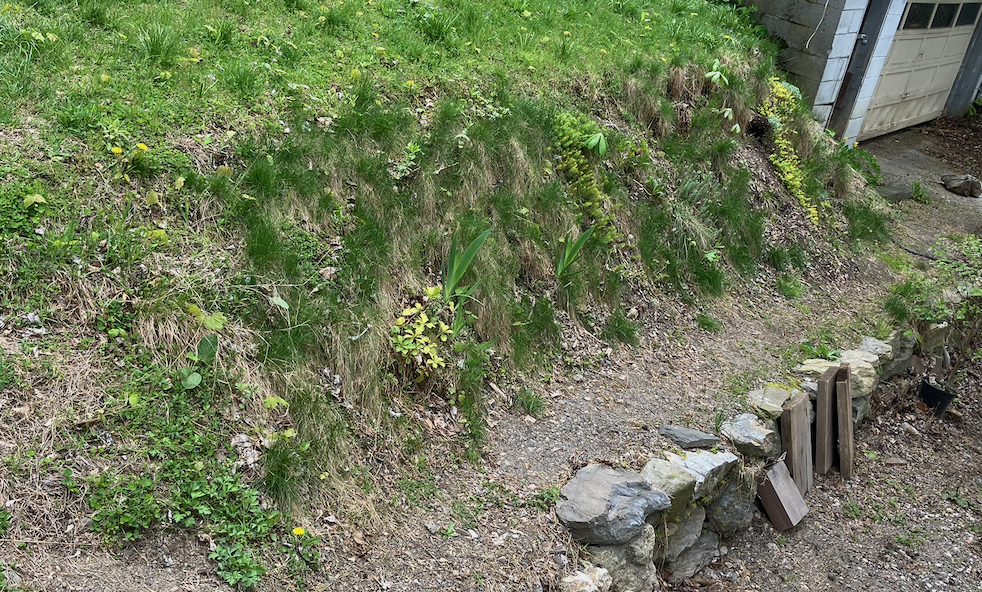
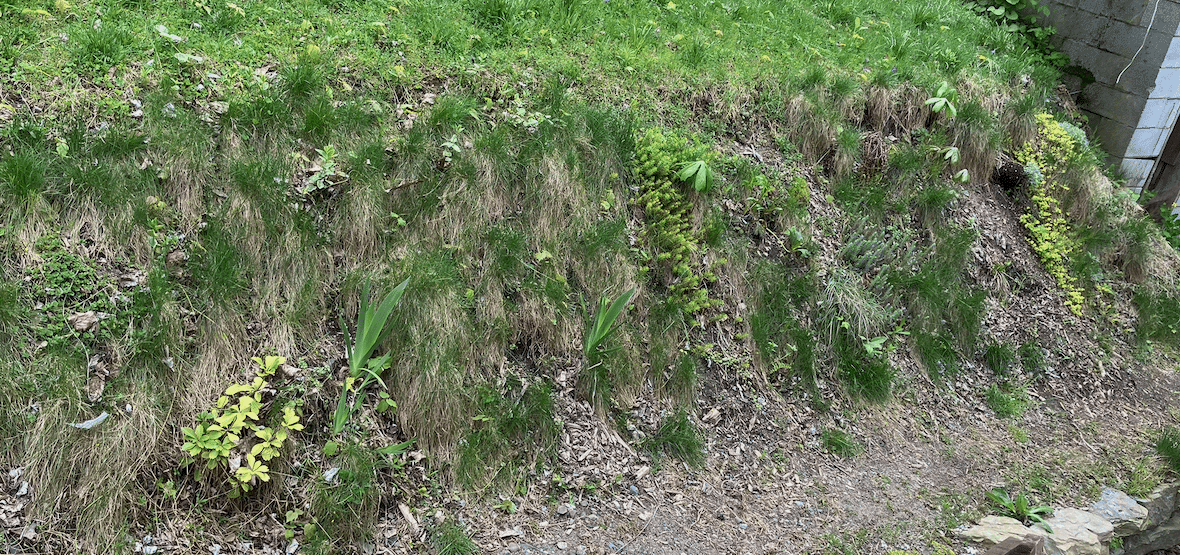
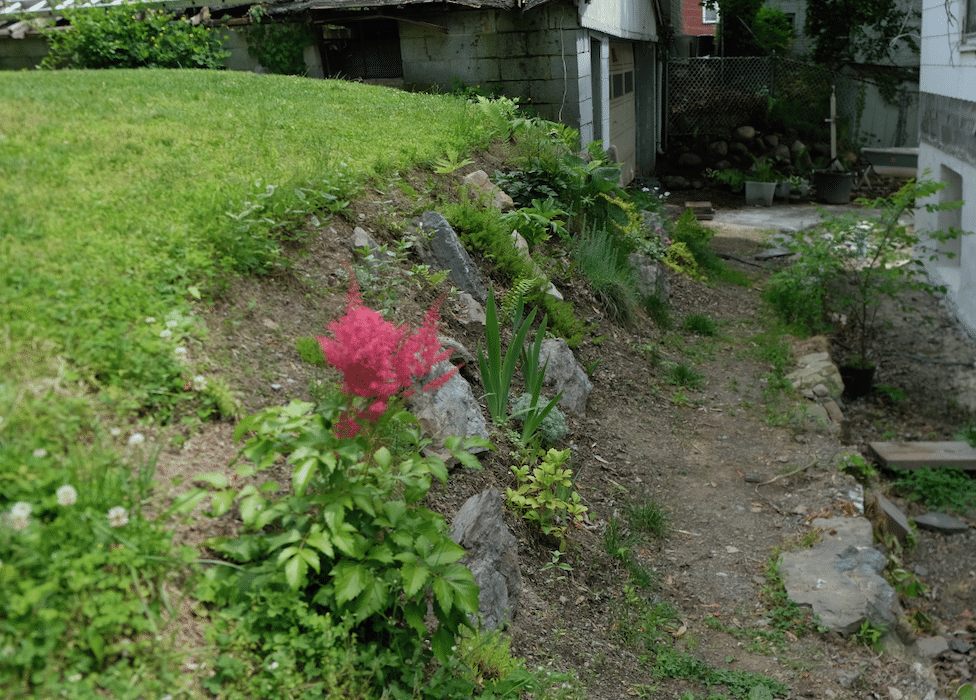
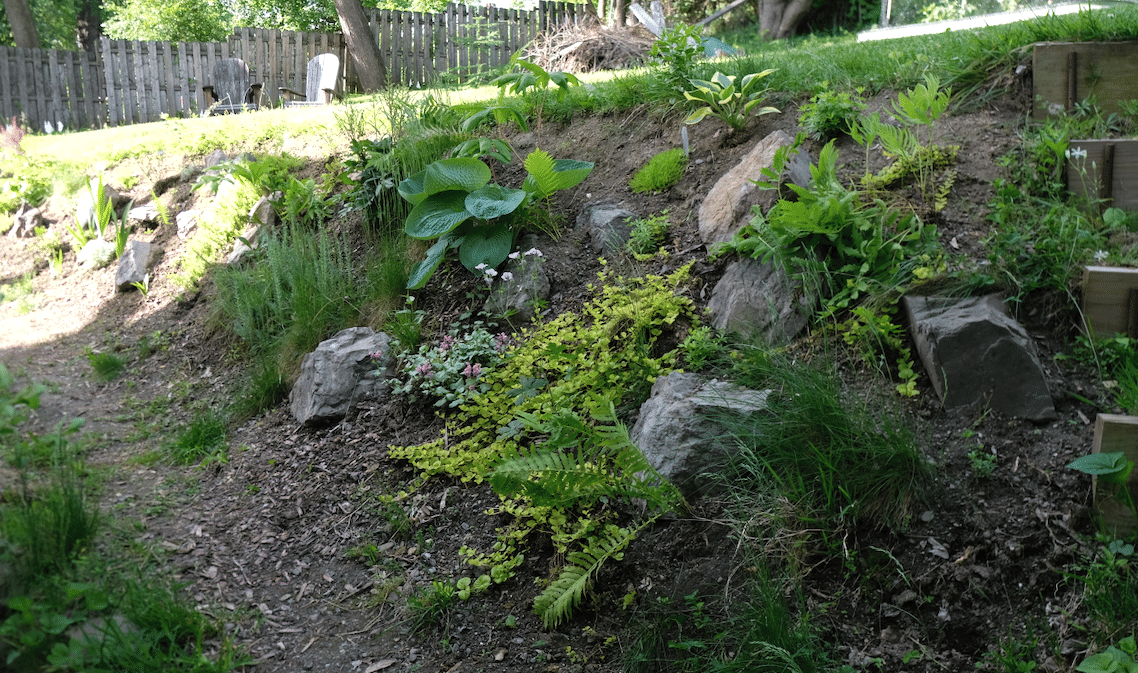
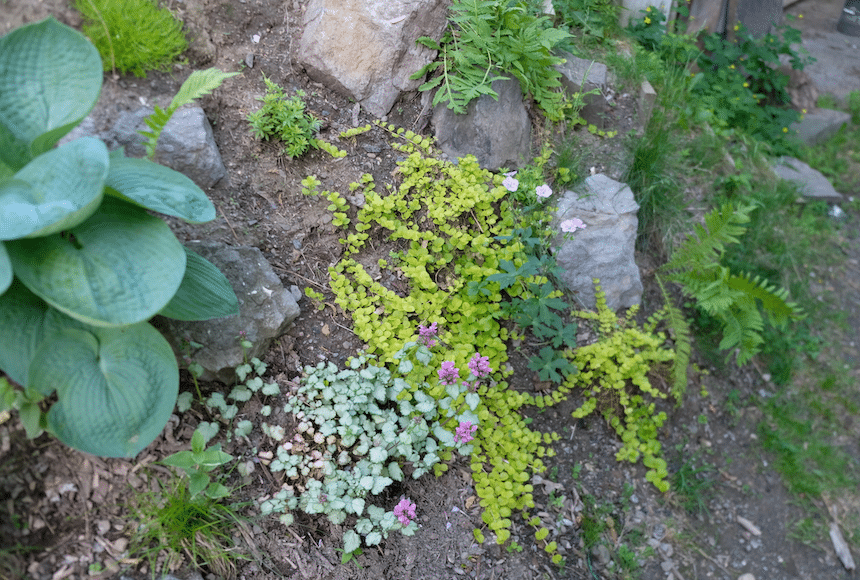
In between door work and cleaning the shop, I’ve been enjoying a bit of gardening. I never used to like it as a kid, but my parents were good gardeners, and fortunately, I did pick up some gardening tips from them. I’ve been working on two shady sections behind the house, and I decided to turn both into rock gardens. The first photos are from behind the house, and this is what you’ll see when you look out the rear windows: lots of ferns, hostas, and a bunch of other plants whose names I can’t remember. It will probably take a while to fill out, and I’ll also be adding some more rocks.

Surreal, but when I was happily weeding the new rock garden, I heard my parents speak to me. It was in my head, so no sound, but it felt 100% from my folks, and they simply said, “We’re crossing over.”

Here are some before and after pictures of the new rock garden. You can see how weedy and neglected it got. It’s nice to have the time to work on it.

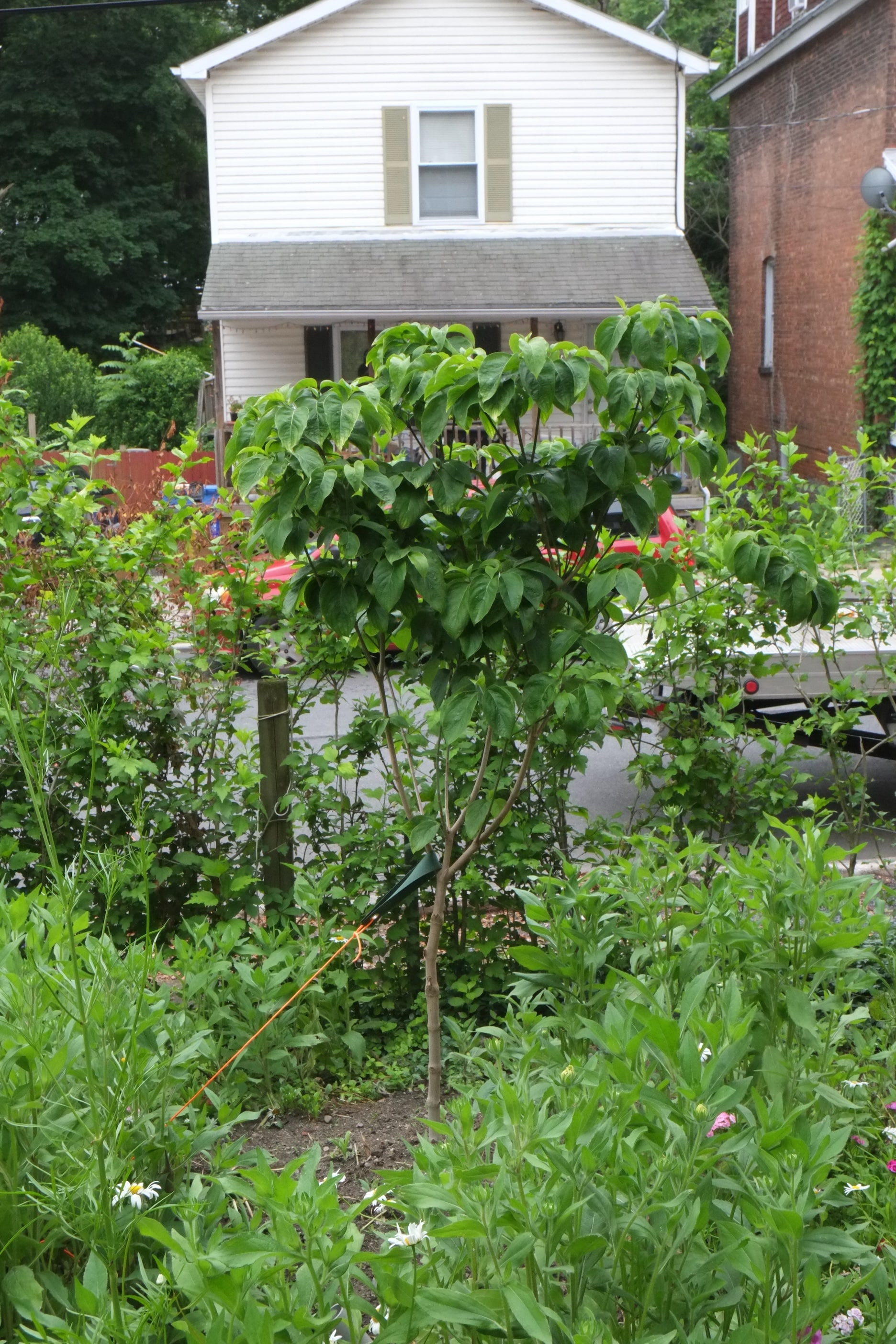
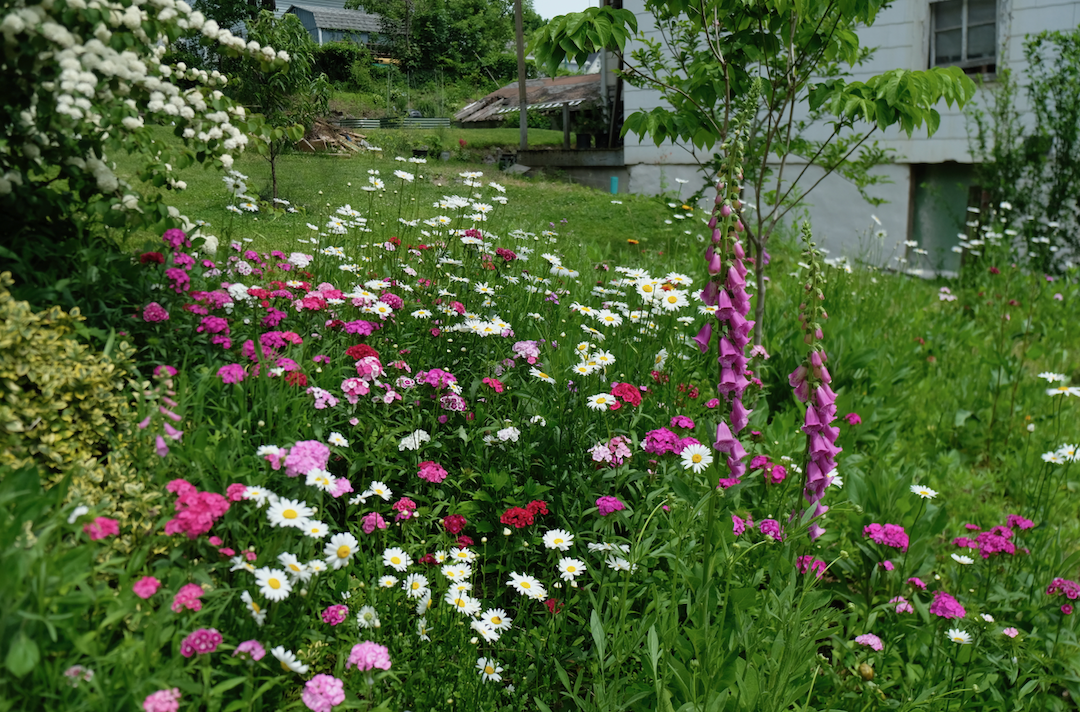
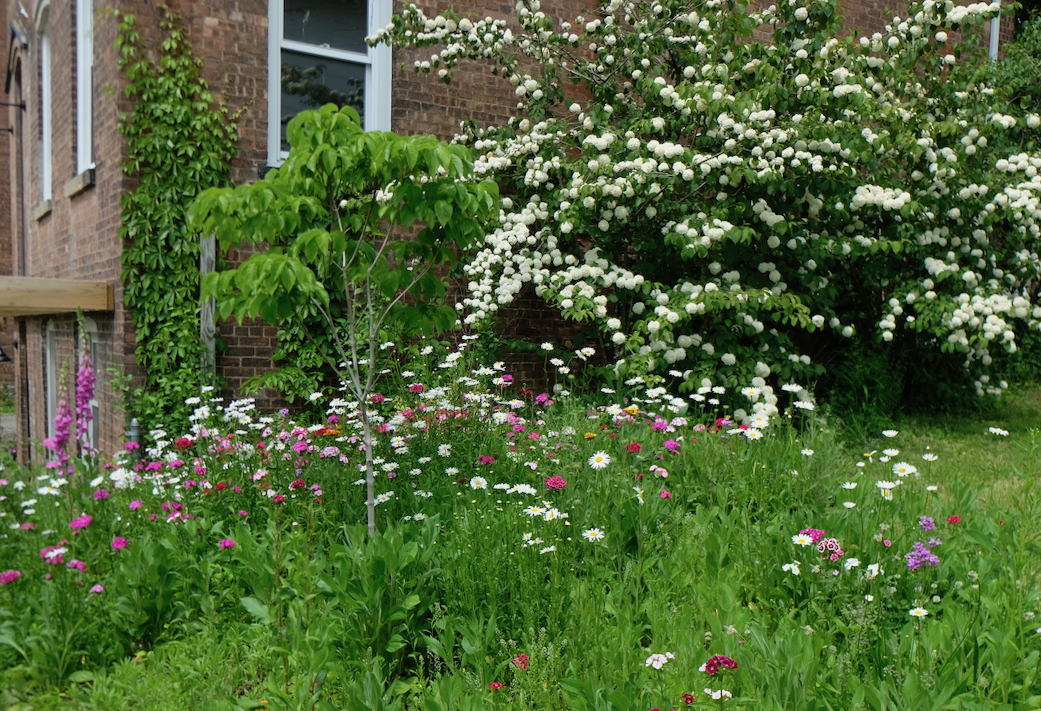
Below we have our beautiful wild flower meadow. It was larger last year but had less color variation. Next year, we’ll extend it and add a stepping stone path through it. The Viburnum, as usual, looks magnificent, and our newly planted dogwood tree is doing great, shame I didn’t catch it in blossom.

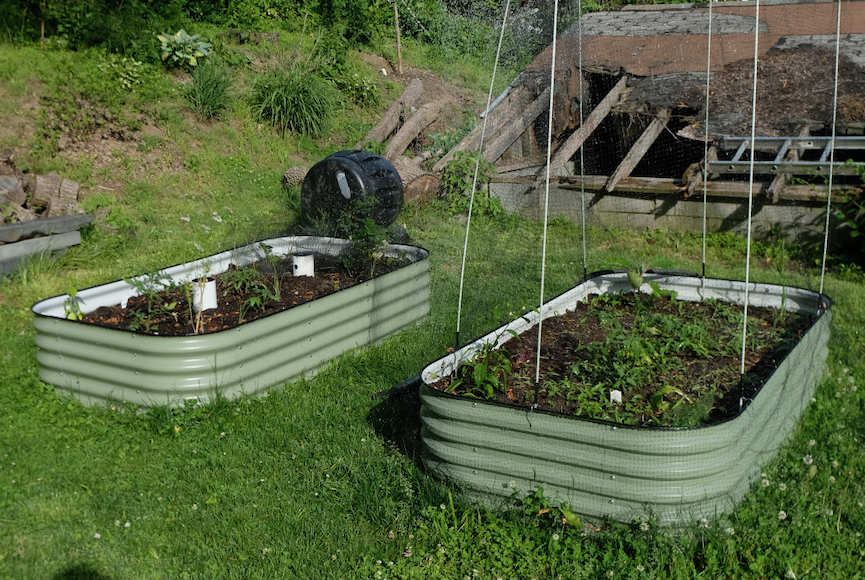
Lastly, our new raised vegetable beds. Netted to protect them from the very cute woodchucks. We learned our lesson quickly when we found all our lettuce, rhubarb, parsley, and dill had been eaten down to the roots. We’re also growing basil, a few varieties of tomatoes, aubergine, leeks, and chilis.

Feels good to be back.

A window shrinks

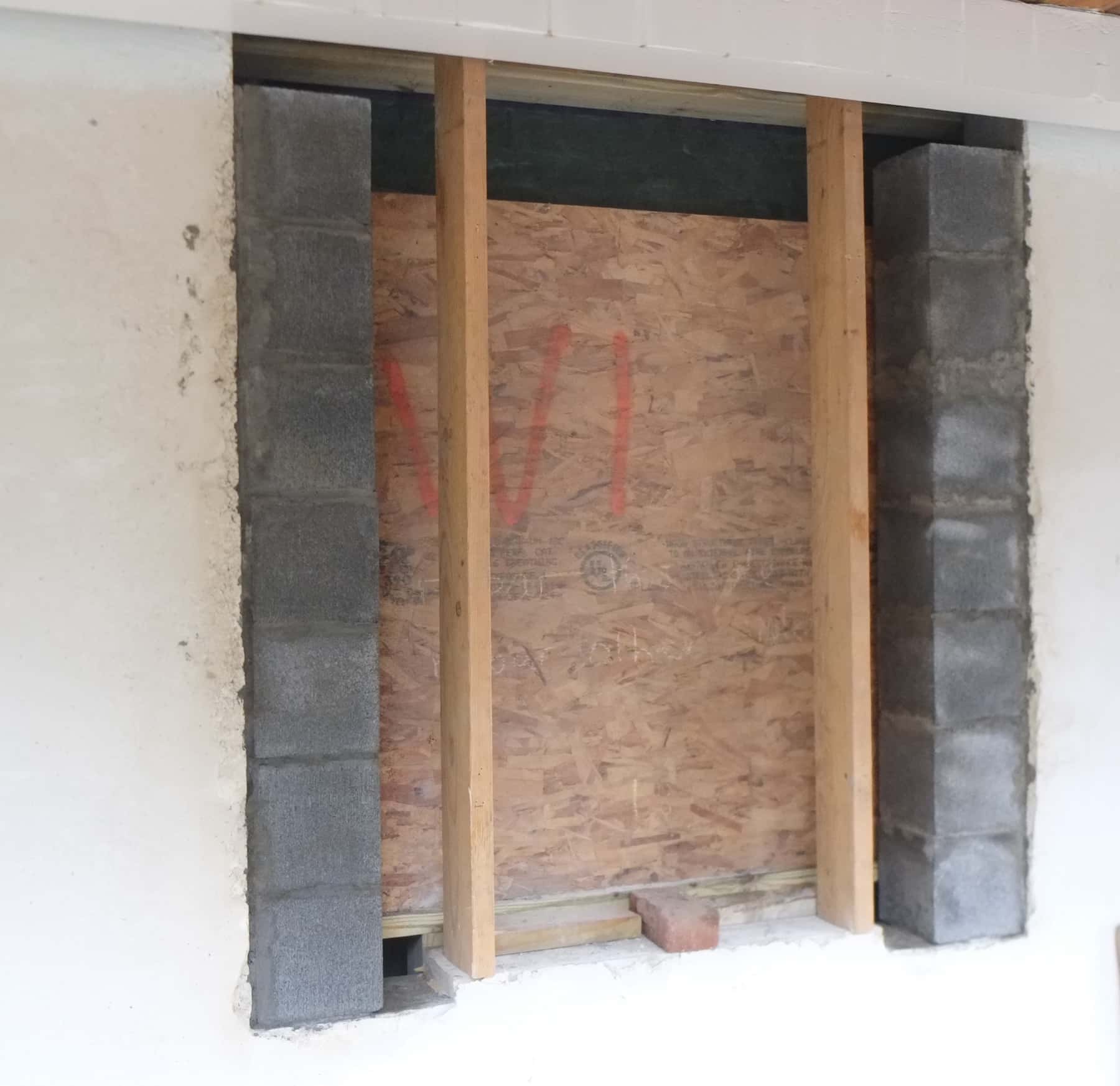
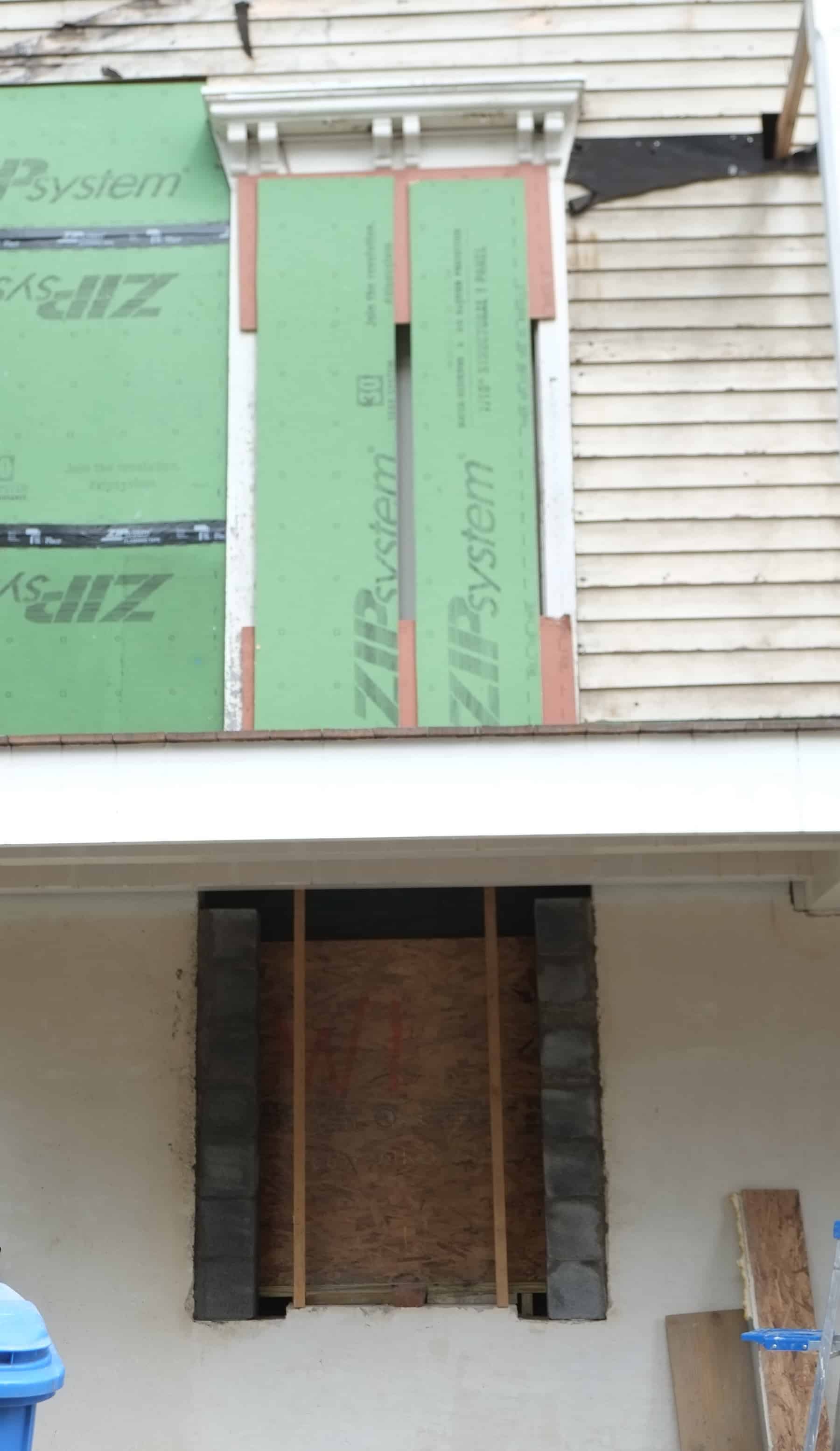
For some reason, when they built the new concrete block wall on the left side of the house, they left a window gap of about 5′ wide, which would be a huge window and not in proportion to the rest of our windows. I’ve probably got better pictures somewhere, but these are the best I can currently find.
To narrow the gap, I used 8″ square concrete blocks, tied into the existing wall with thick galvanised wire and filled internally with concrete and rebar. My brick-laying skills are poor, but after a light pass of the grinder it was perfect! The new width is now comparable to that of the other windows. I intentionally left a gap above the blocks to install a lintel, as the window couldn’t go that high.

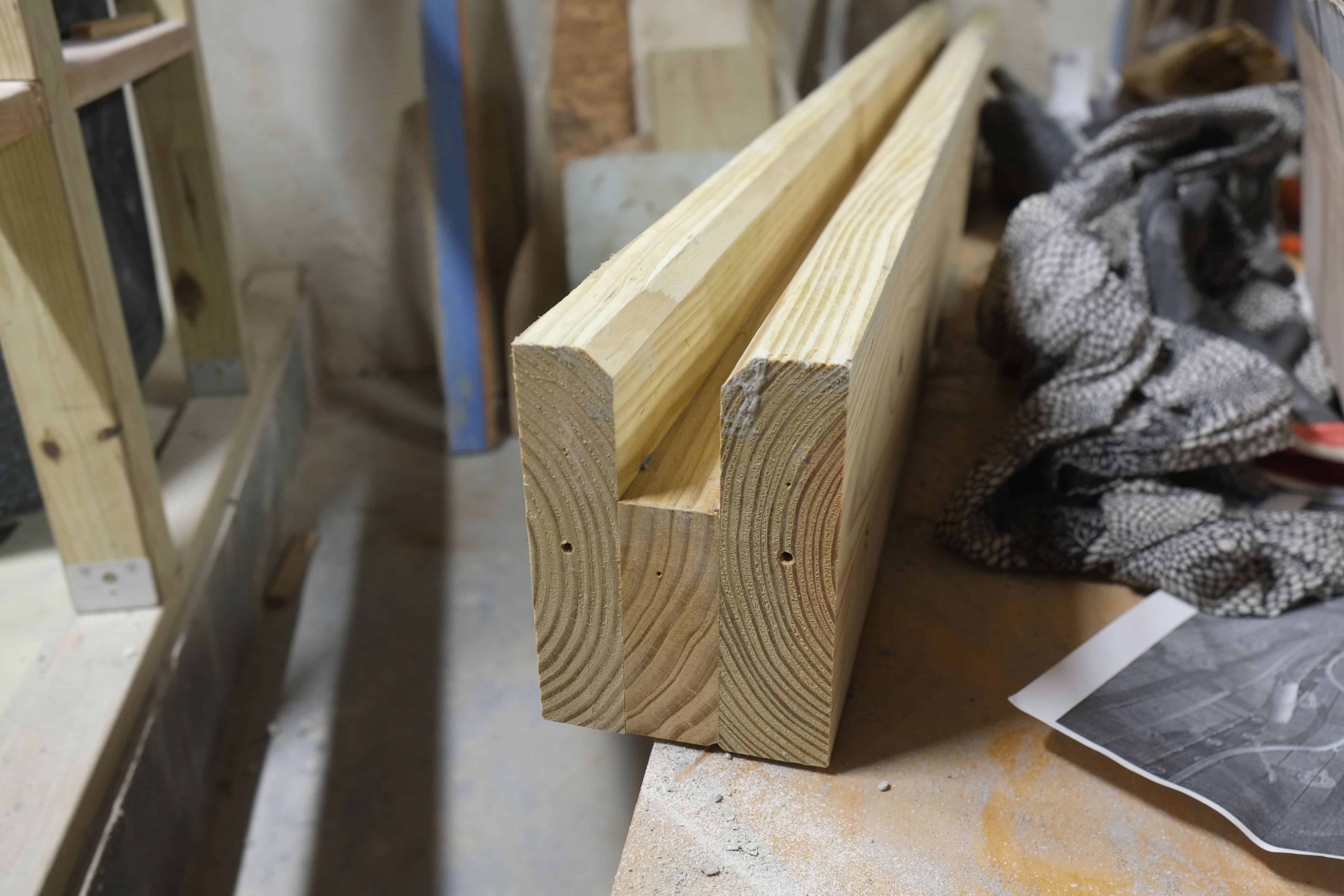
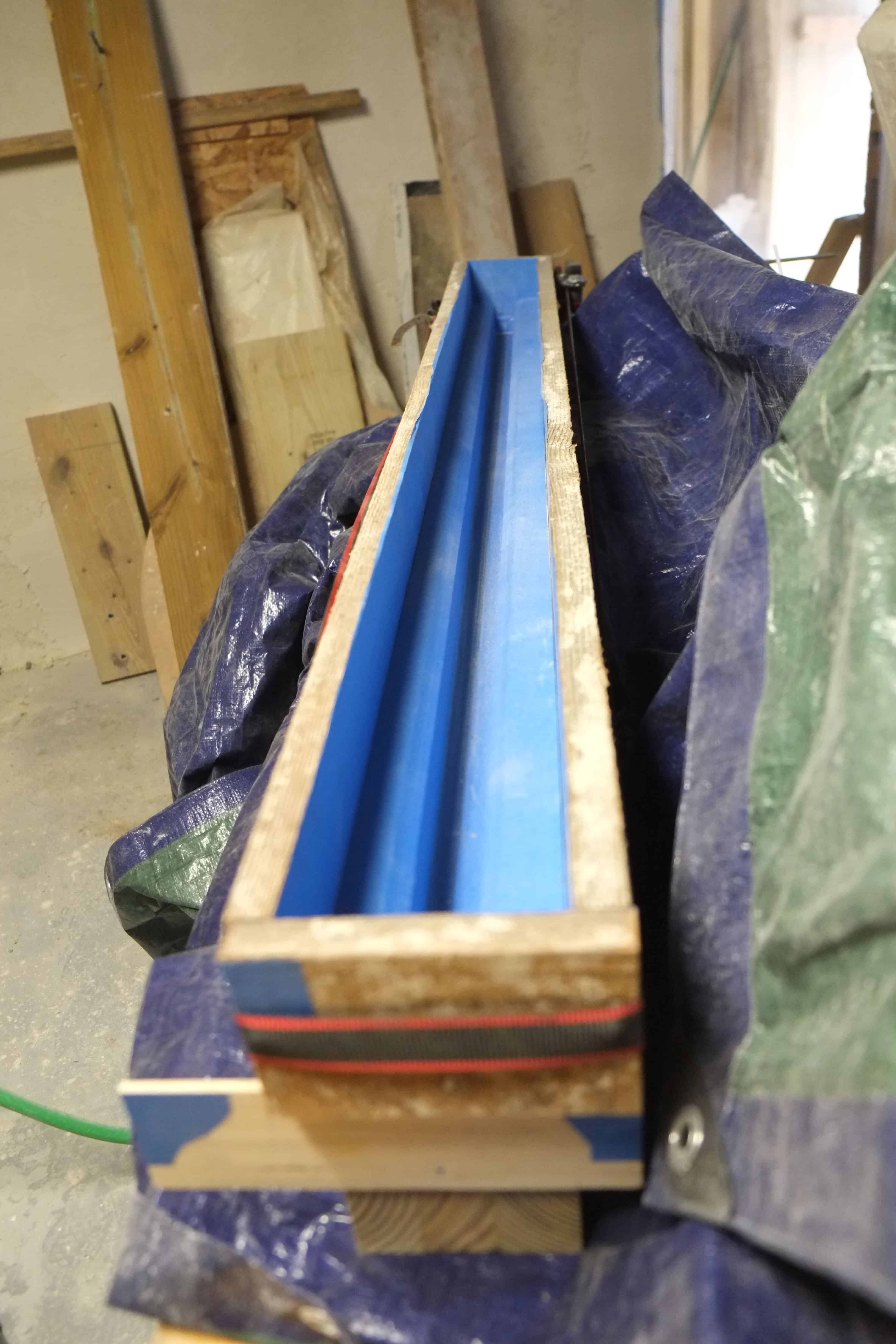
Regarding the lintel, I couldn’t find the right size locally, so I made one myself. To ensure I could lift it, the inner side was pressure-treated wood, and the outer side was concrete, reinforced with rebar. That said, it was still too heavy to install safely from the top of a step-ladder.

The make the lintel, I first made the wooden section, applied masking tape as a release layer, added shuttering and rebar, and then poured in the concrete. Once the concrete was cured, I prised the two apart so I could lift them separately.


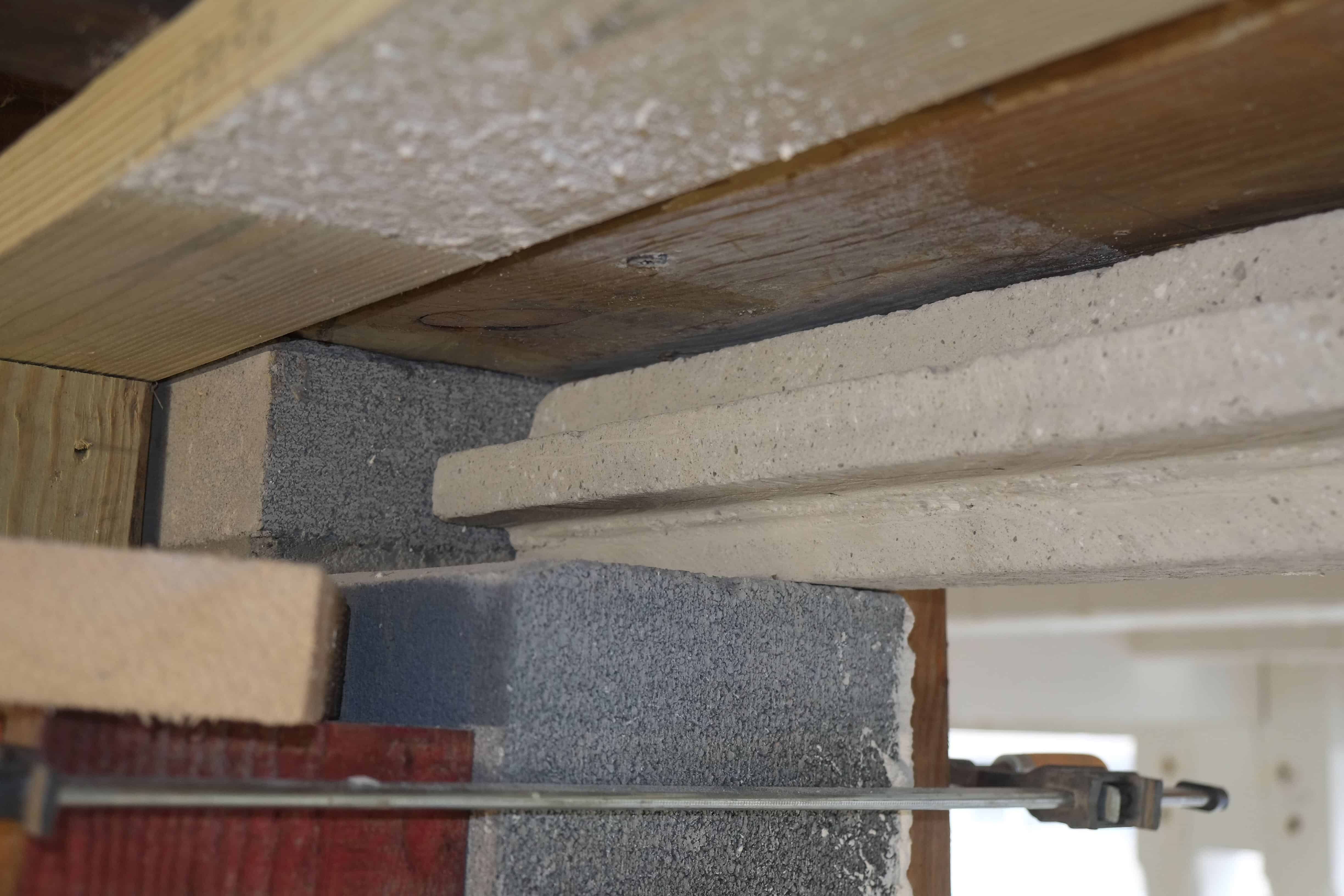
First to go up was the outer concrete part, and for this, I had to add a series of blocks so I could gradually get it to the correct height and then slide it into place.

With the concrete section part in place, I bonded the wooden section to the concrete section. I know it doesn’t look much, but I’m pretty pleased with how it looks, all in all a good job, without any mistakes 🙂

Fixing a hole

We recently had our plumber over to assess our needs, and while he was there, he took a look at our tub and said that we’d need to drill through our concrete floor so that the water supply lines for our rim-mounted faucets could go down into the concrete and across into the framing. I’m not sure why this wasn’t considered before we had the concrete pour.

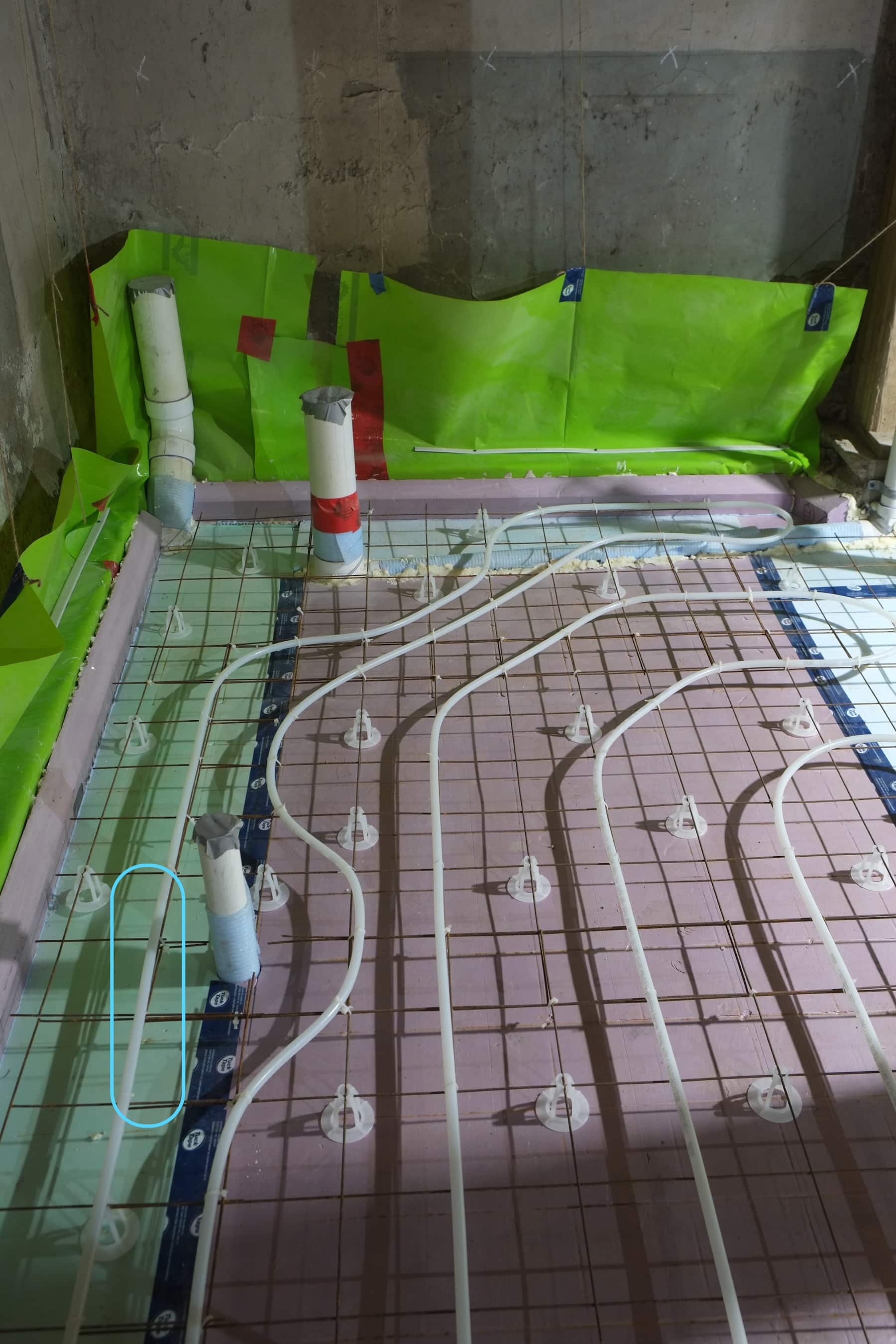
To keep the cost down a bit, I volunteered to remove the concrete as I had a good idea where all the PEX pipes for our radiant heating lay. I don’t have a detailed map of where the radiant pipes go, but I did take a lot of photos before the concrete was poured. When cutting into such a floor, there is always the worry that you’ll damage the PEX and you can probably guess where this post is going.
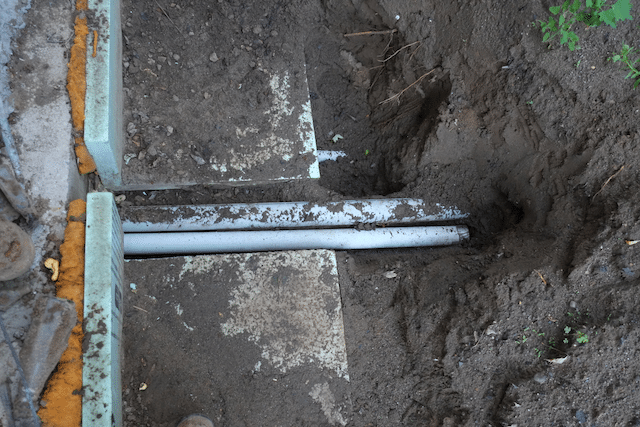
I’ve highlighted the section of Pex that I had to be careful of.

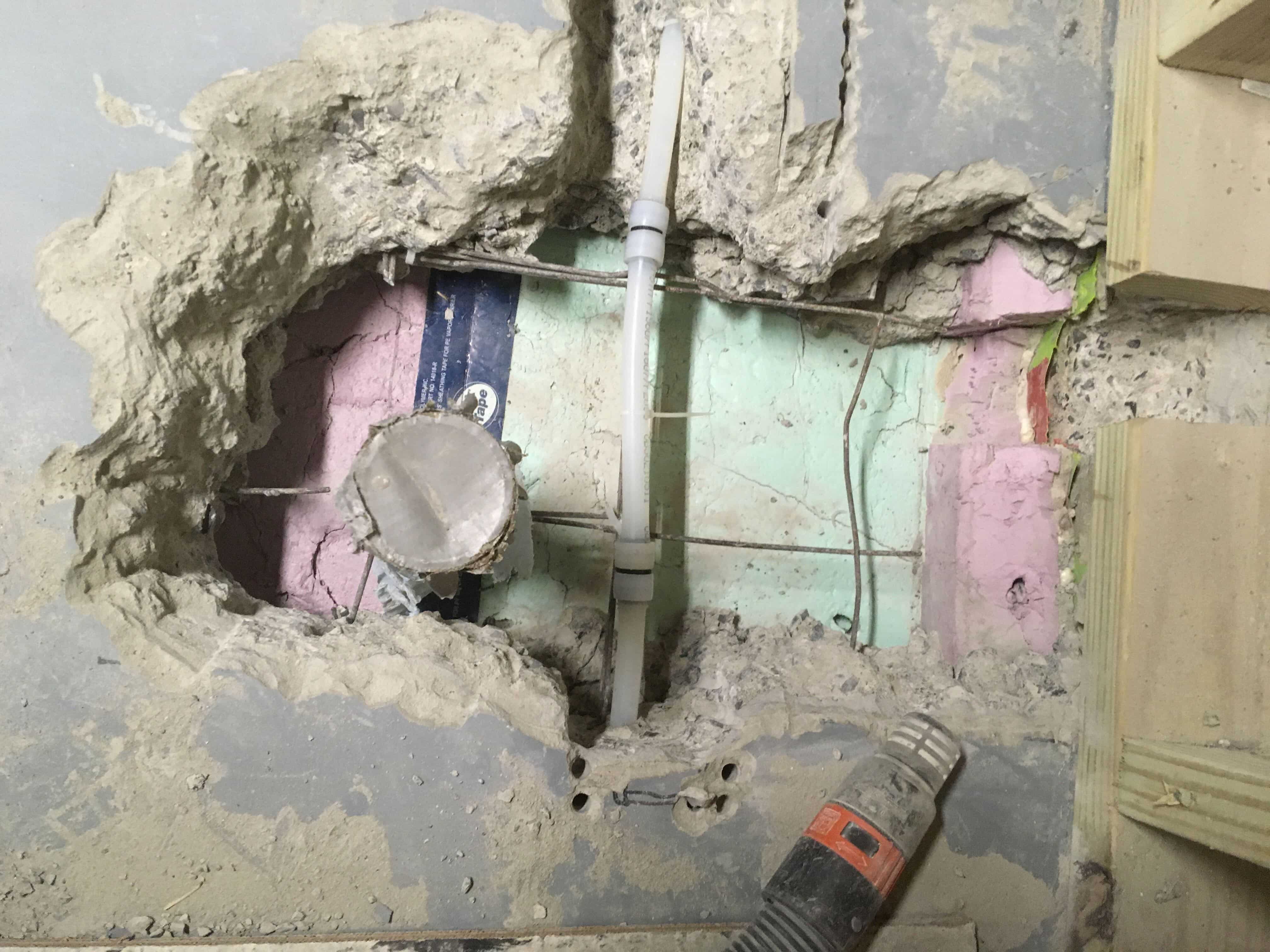
I marked with a Sharpie where not to drill and then went to work with my big jackhammer, which was a mistake. The jackhammer makes easy work of breaking up concrete, the downside is that it bounces about a bit,  accuracy isn’t its forte. When I did uncover the pipe, I noticed one dent and one hole in it, definitely my fault, as that hole would have been discovered during the pressure test.

Replacing the damaged pipe meant exposing more of it, and for this, I used a smaller hammer drill to first drill a series of holes and then a bunch of different chisels. Once I got the hang of where to chisel, it was pretty easy, and 30 minutes later, I had exposed enough pipe to cut the bad section out.

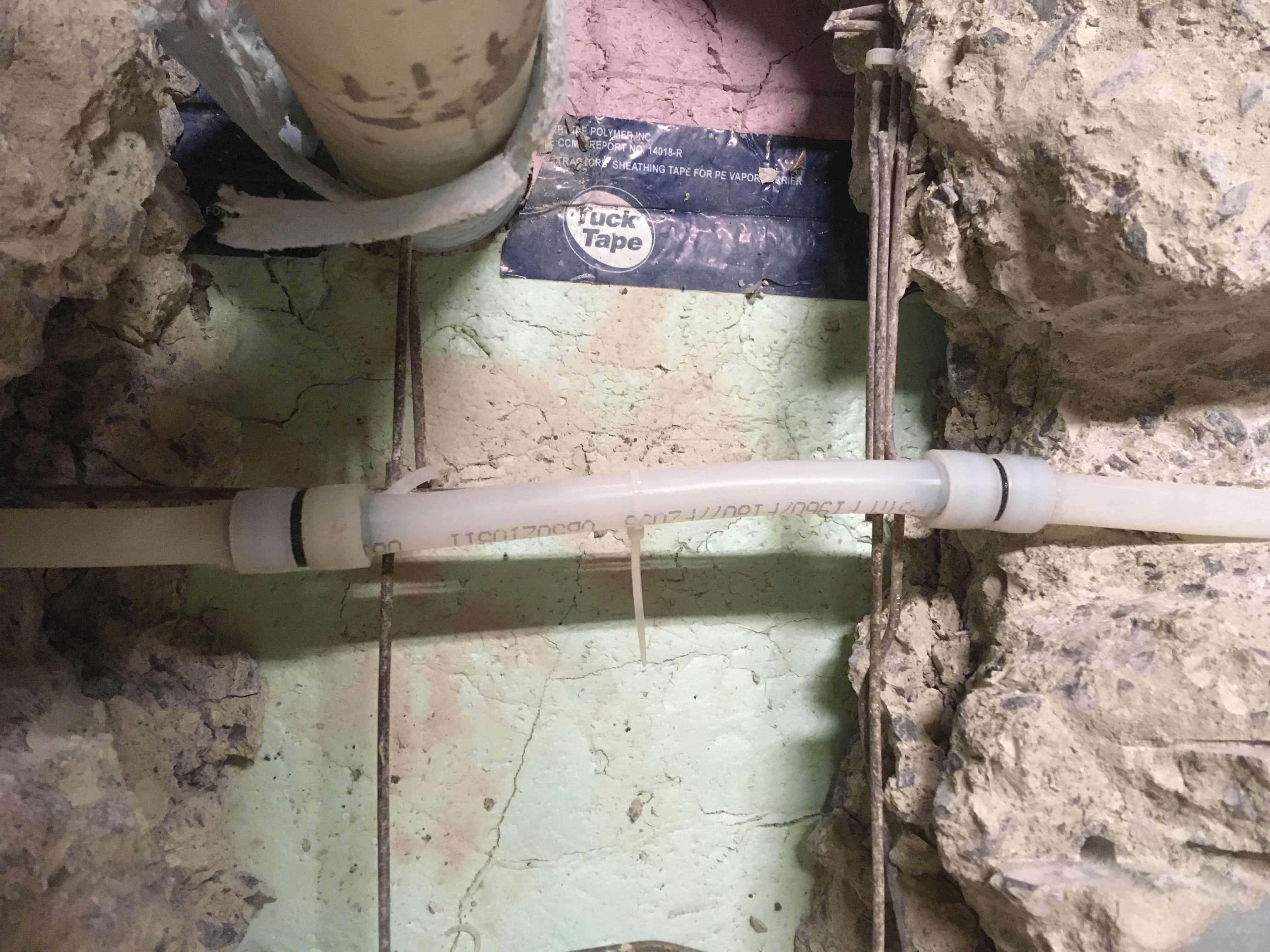
We’re using PEX A (Uponor) in the house, and I’d like to thank John Paul for letting us use his PEX expander tool. The expander tool is pretty neat, and if you’ve never seen one in action, here is a quick video of how it works. PEX A always wants to return to its original shape, so a joint is never going to loosen.

The actual repair took less than 5 minutes, and I’m glad I’ve been through the process of making such a repair, just in case another pipe gets damaged in the future.

Bathroom fixtures and tiles

Following up on our last post, these are the projects that we’ve been working on.

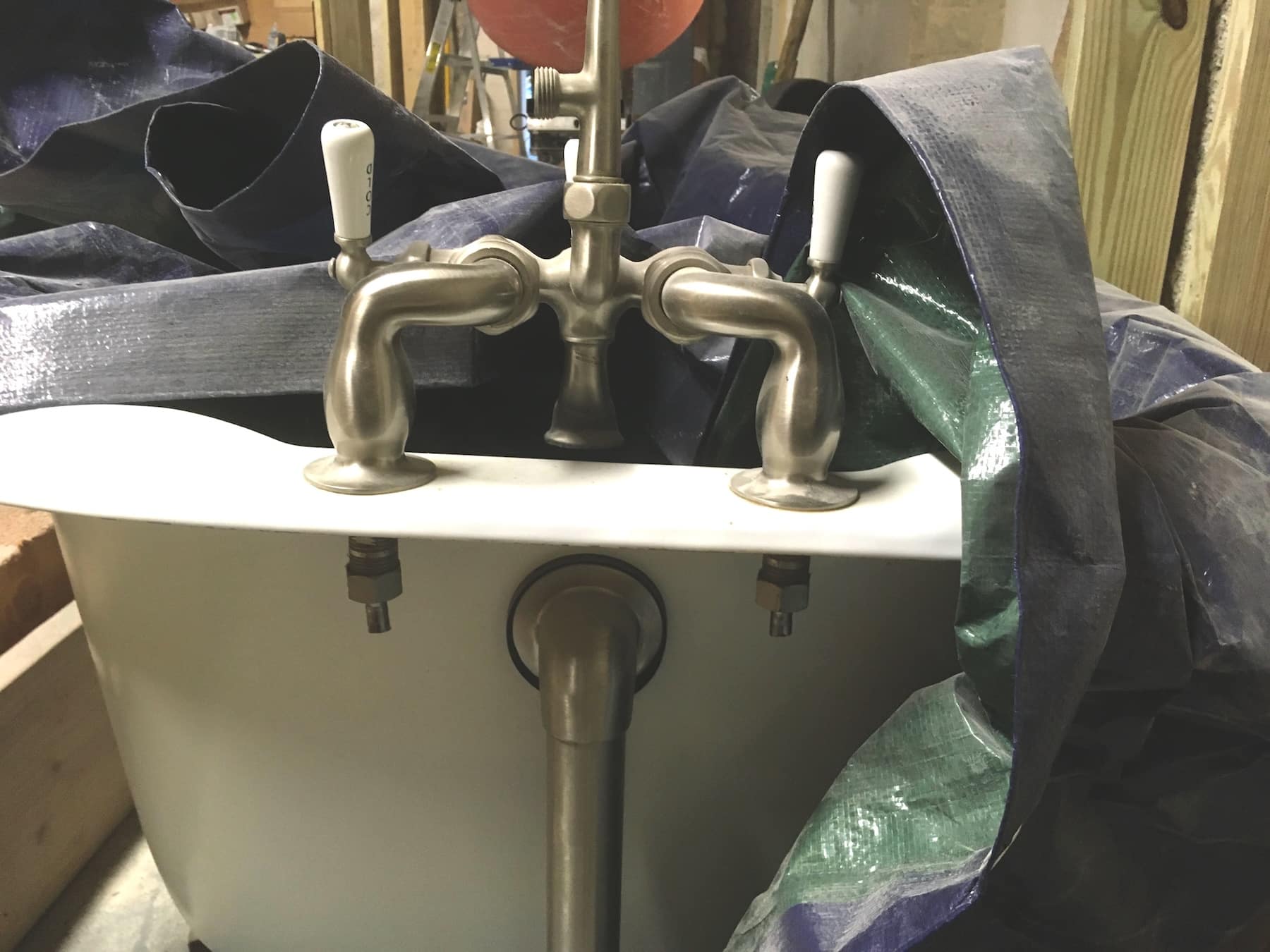
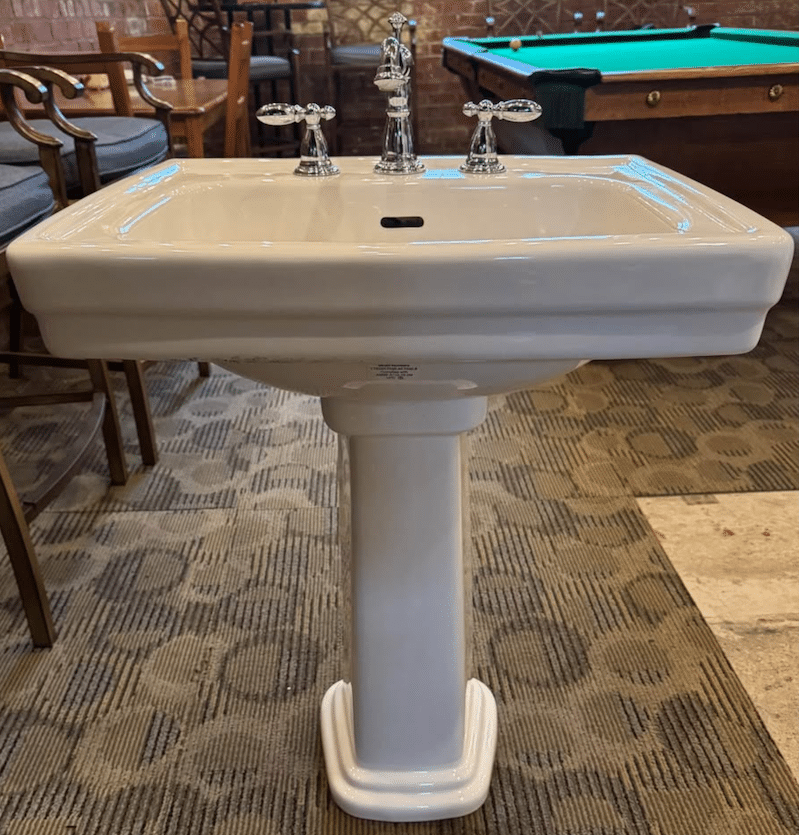
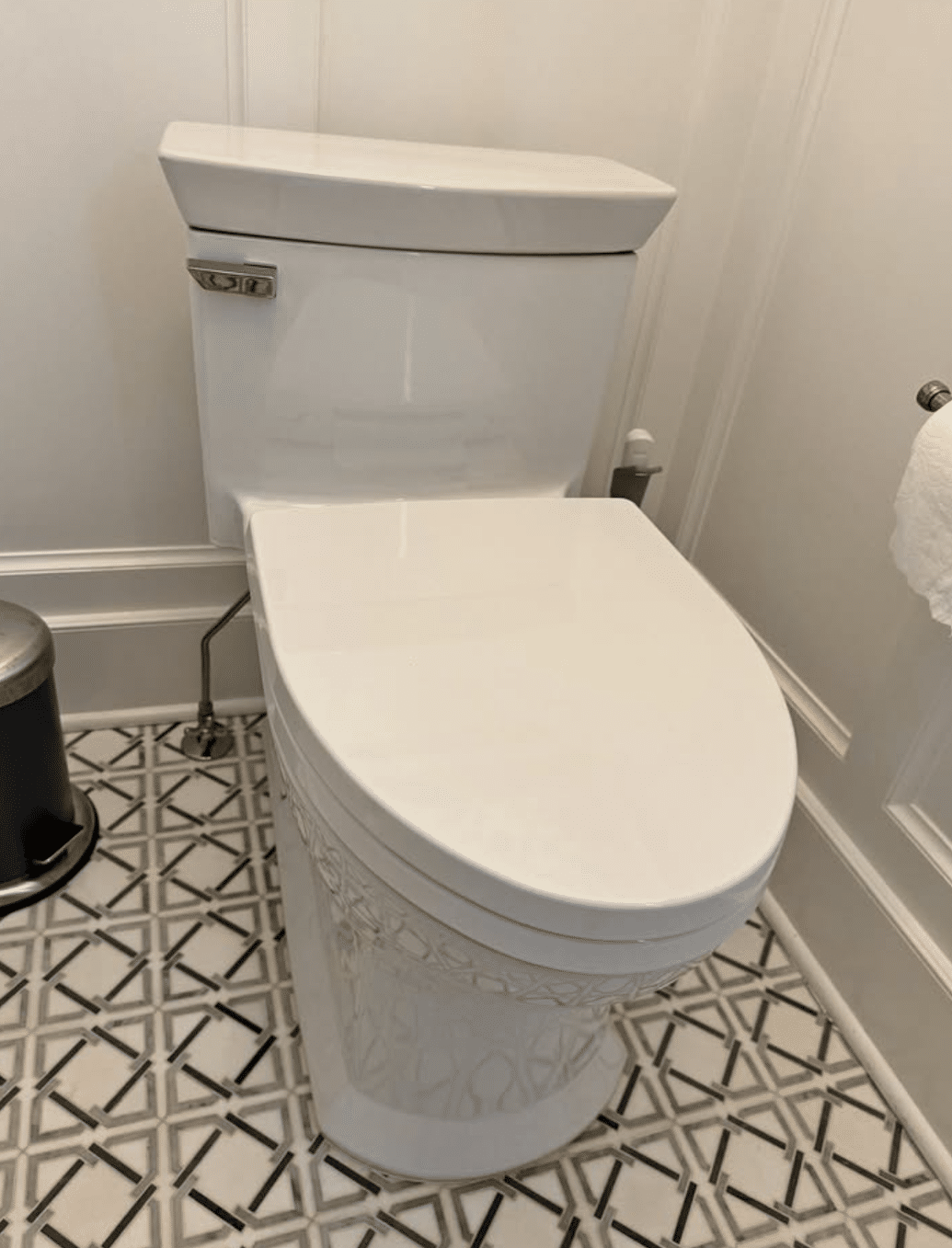
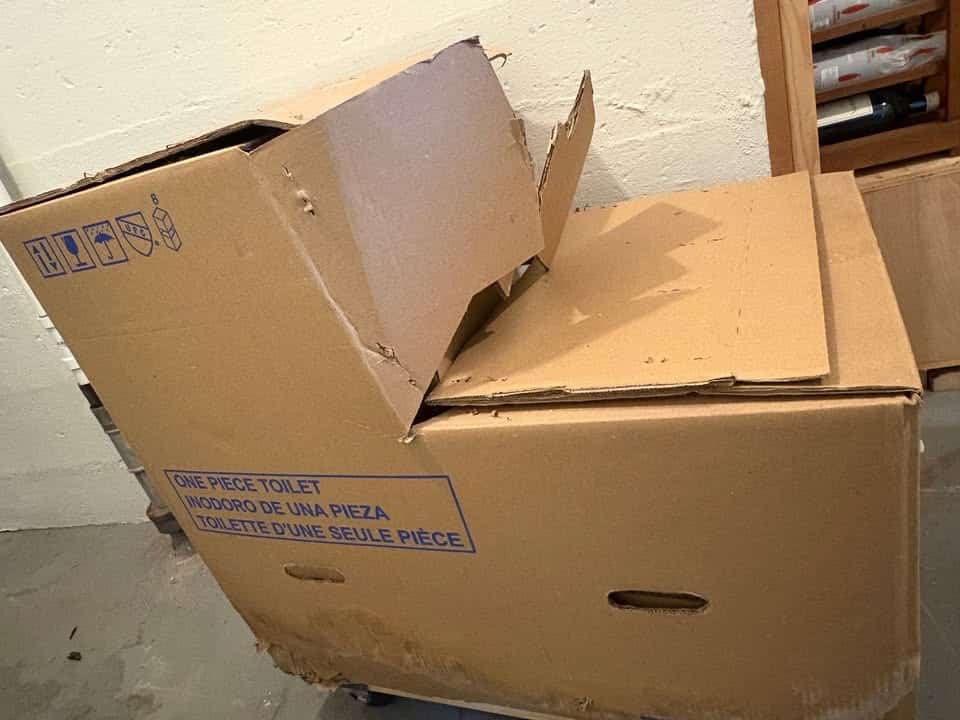
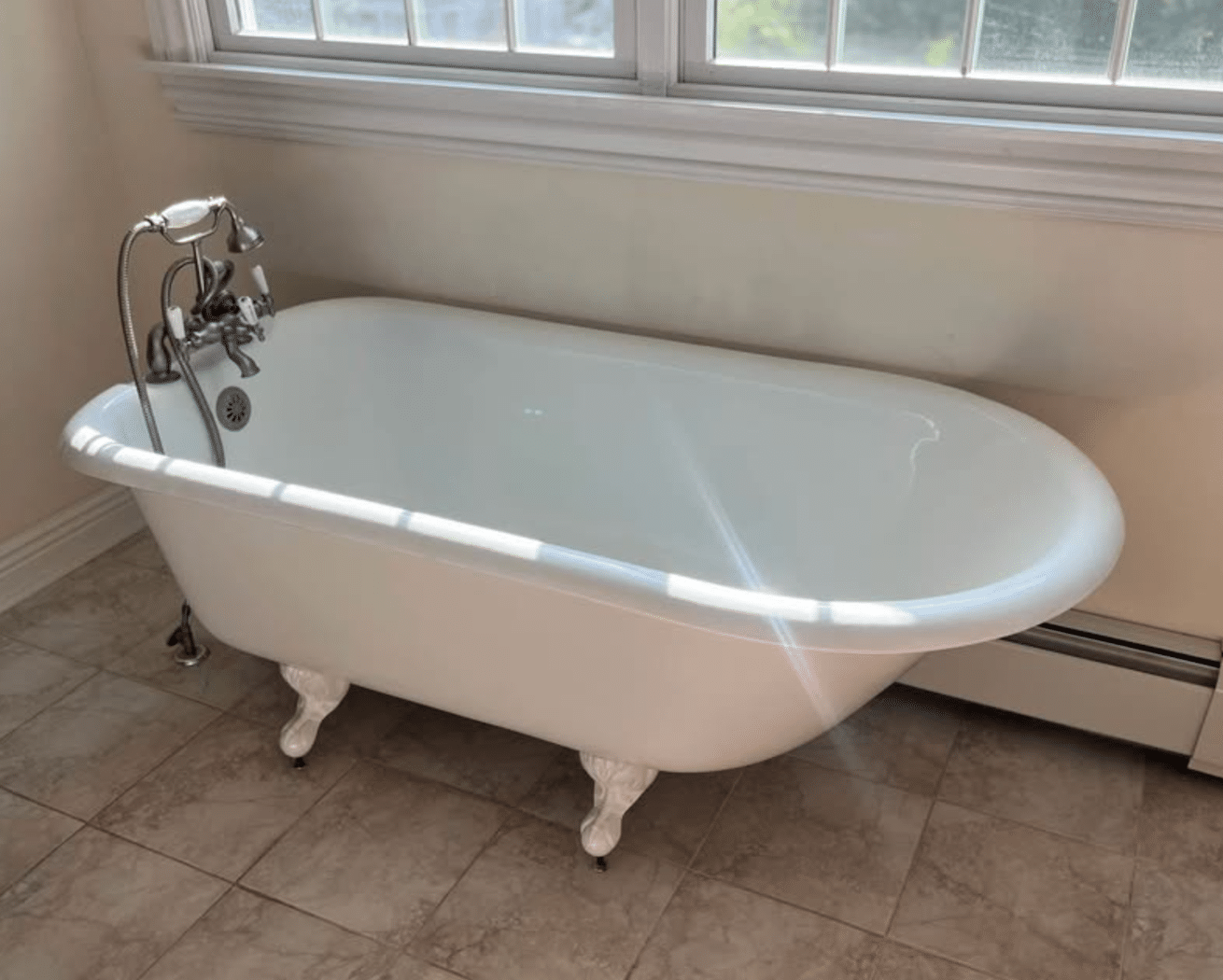
As we get closer to hiring the plumber, our friend John Paul suggested that we purchase the bathroom fittings, so we can determine exactly where the water pipes need to go. To this end, we’ve been scouring Facebook Marketplace. First thing we got was a lovely sink by Toto from Scranton, PA, bit of a drive, but the seller and the sink were both lovely and you couldn’t tell that it wasn’t new. Second purchase was a nice Toto Toilet, second hand, but never installed and still in the cardboard crate, thank you James. Lastly, we picked up a great cast-iron bath from Jake. It is 3″ shorter than my ideal length (based on my parents bath), but I’m sure it will be fine, and if it isn’t, we’ll get a longer bath for upstairs.

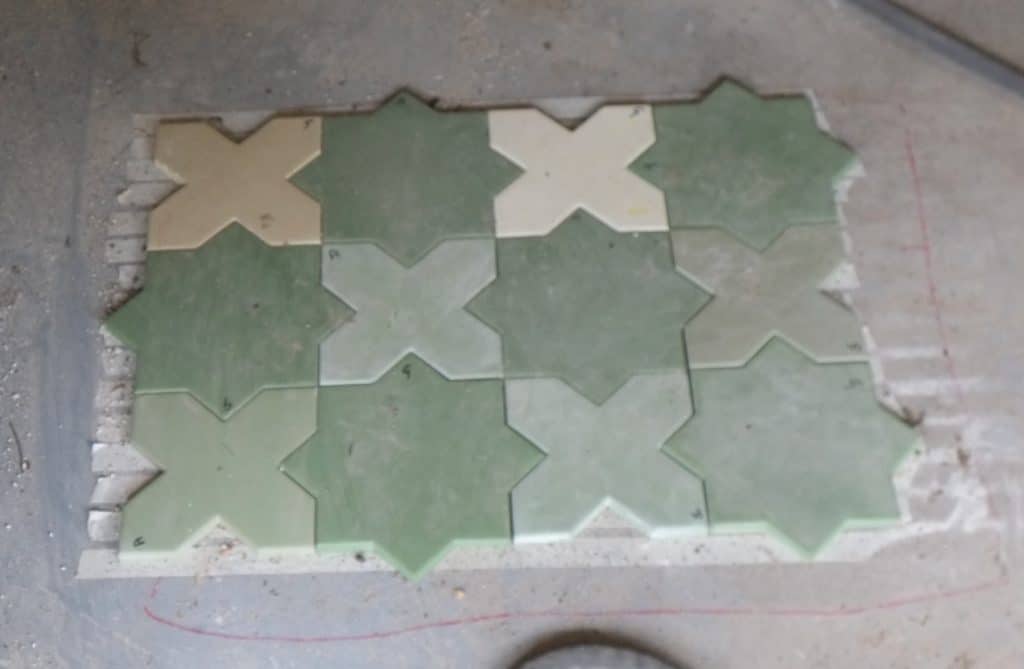
A few posts back, I mentioned we were casting concrete tiles. We been a bit amiss of late, and haven’t made any recently, however, we have been testing the tile sealers. The candidates are from Green Building Supply and Tile Armor. With double sided tape we stuck down a bunch of them in our entrance way and marked which primer we used. They’ve been down now for about six weeks, and I have to say that they have stood up well to some harsh, abrasive conditions, sand, grit, mortar etc. Testing continues.

I’m still struggling with health issues, which is slowing me down a lot. Dr. said that my medication is likely to contribute to my fatigue and general sense that my body is feeling sour, difficult to describe, but that is the best I can do. When I’m on steroids I’m great, but when I taper off them, the condition returns. I’d love to stay on steroids but the side effects are bad and can be permanent. Condition is extreme eczema, which came out of the blue. Do an image search and you’ll get the idea. I’m pretty much seeing the Dr. every week to two weeks.

We’re still here

Apologies for the lack of posts, I’ve been having health issues, which have slowed me down. Still not fully recovered, but hoping I’m heading in the right direction.

All that said, we have done some work on the house, and I’ll lump these smaller tasks into the next few posts.

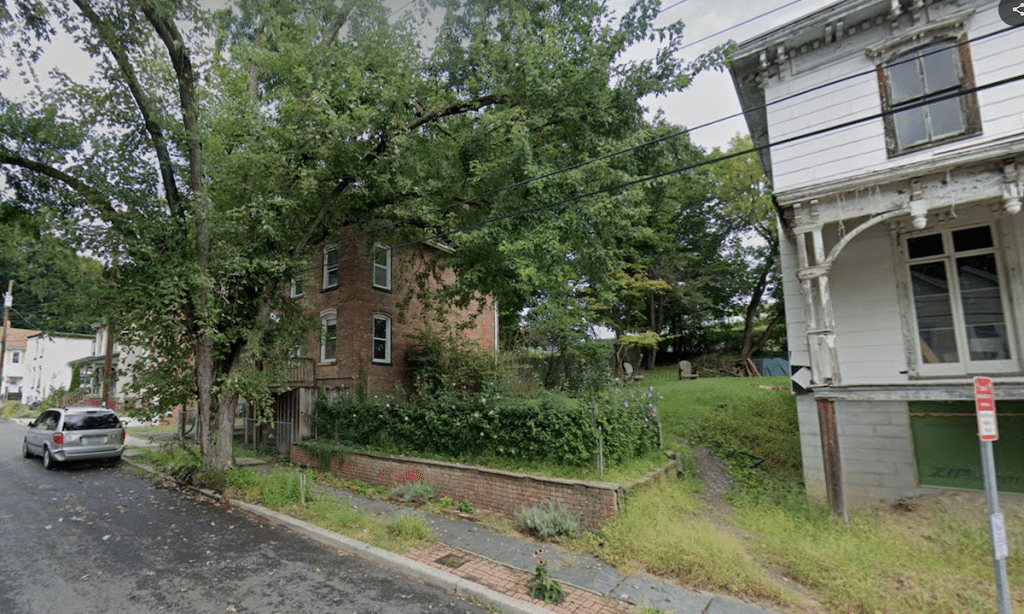
Some of you may know that we have a large silver maple growing on our pavement/sidewalk. Our neighbor wanted it removed due to safety issues and although we partially agreed with them, we’d rather the tree remained, possibly with a good pruning as it gave us shade and privacy.

In the end, the tree was sadly removed, and what a difference its made to the street. All of a sudden, the street looks very open and plain, and we have lost privacy and shade.

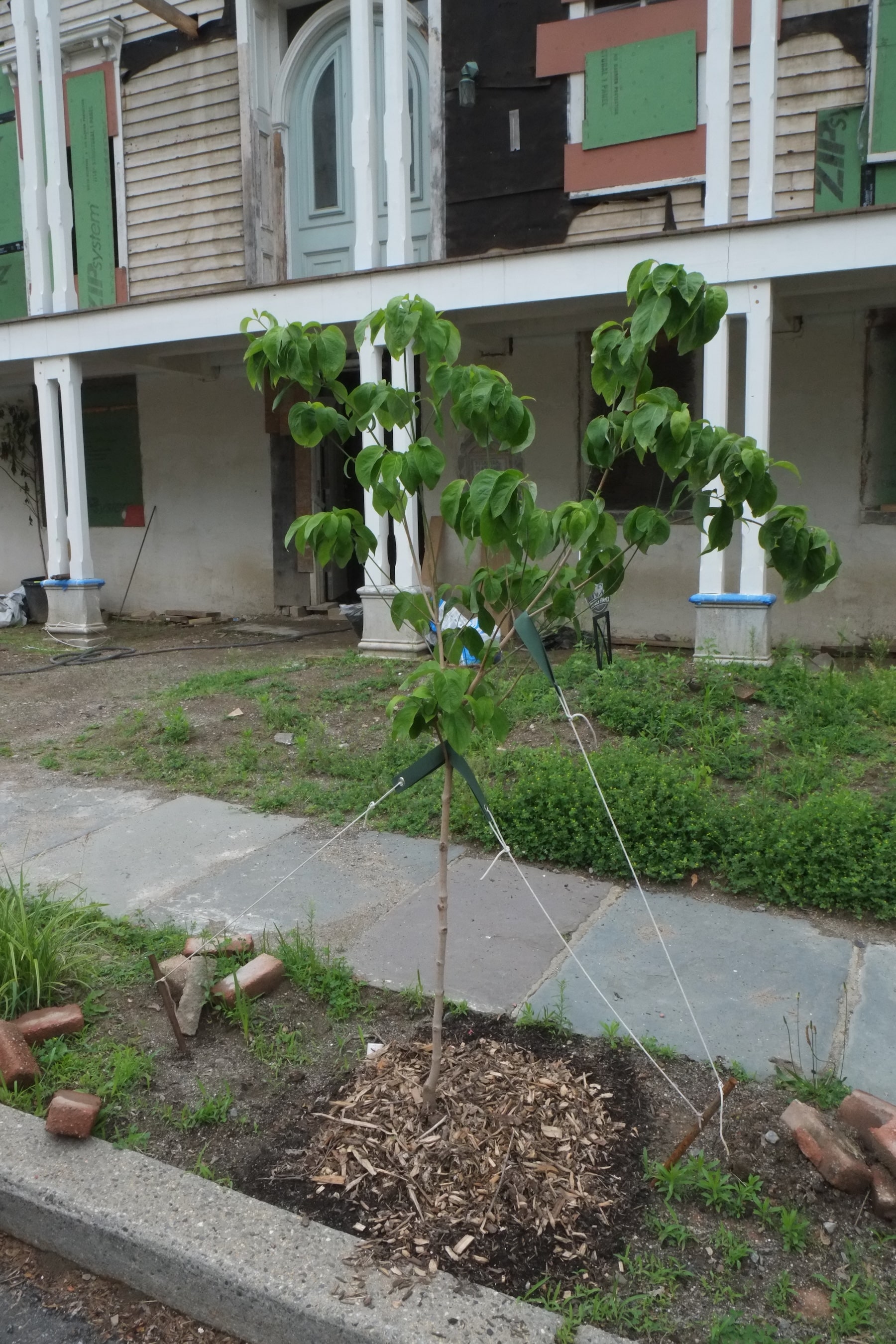
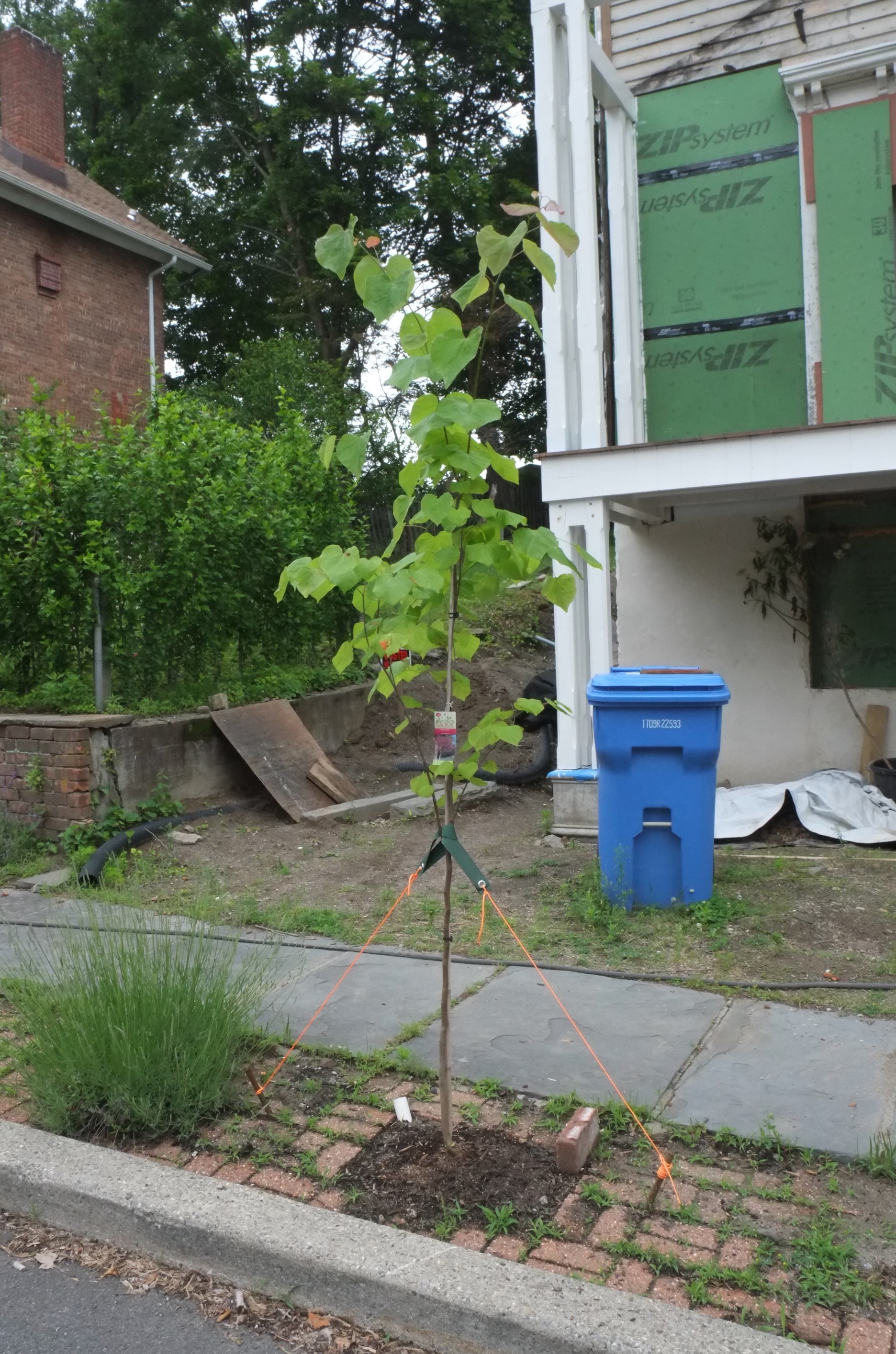
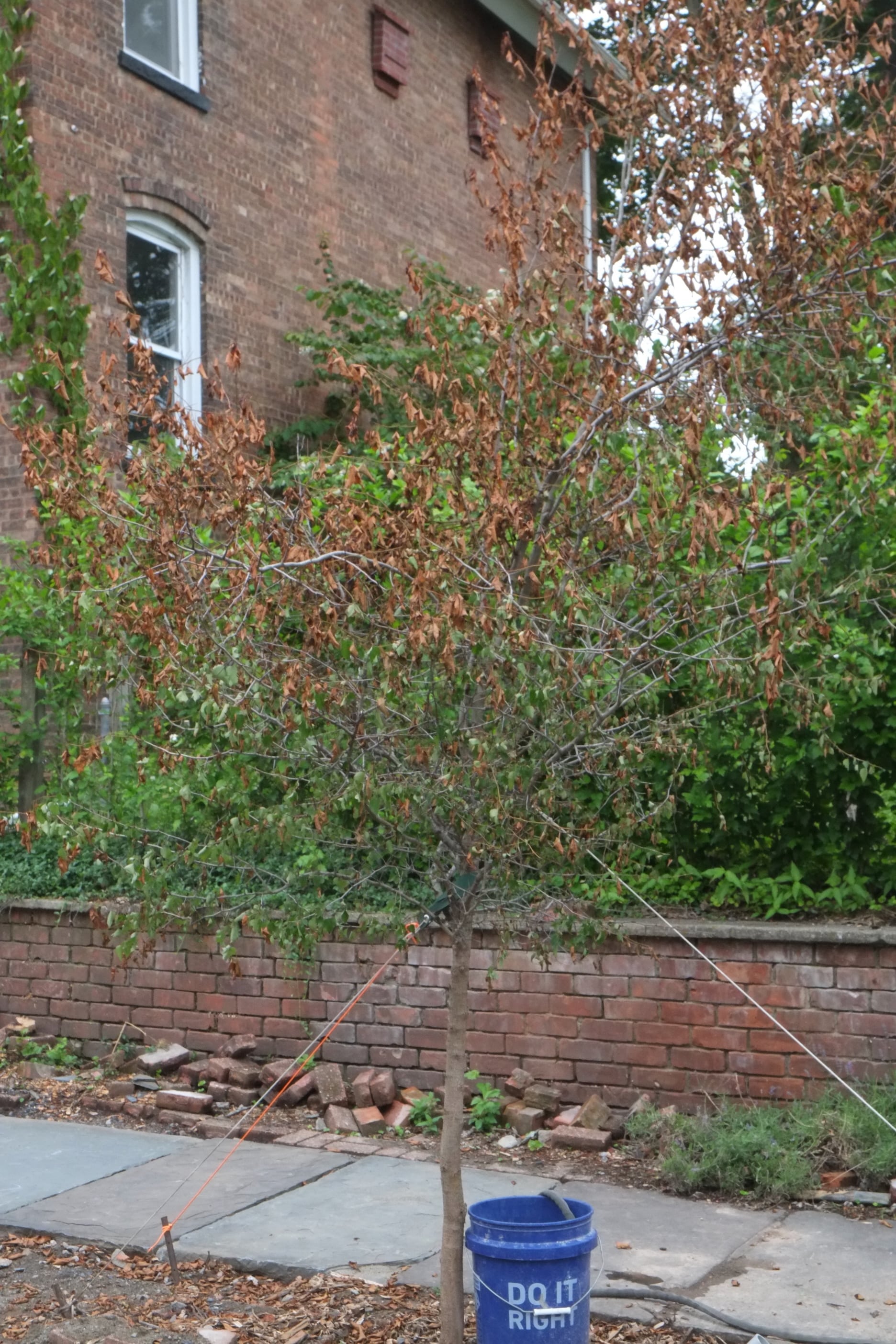
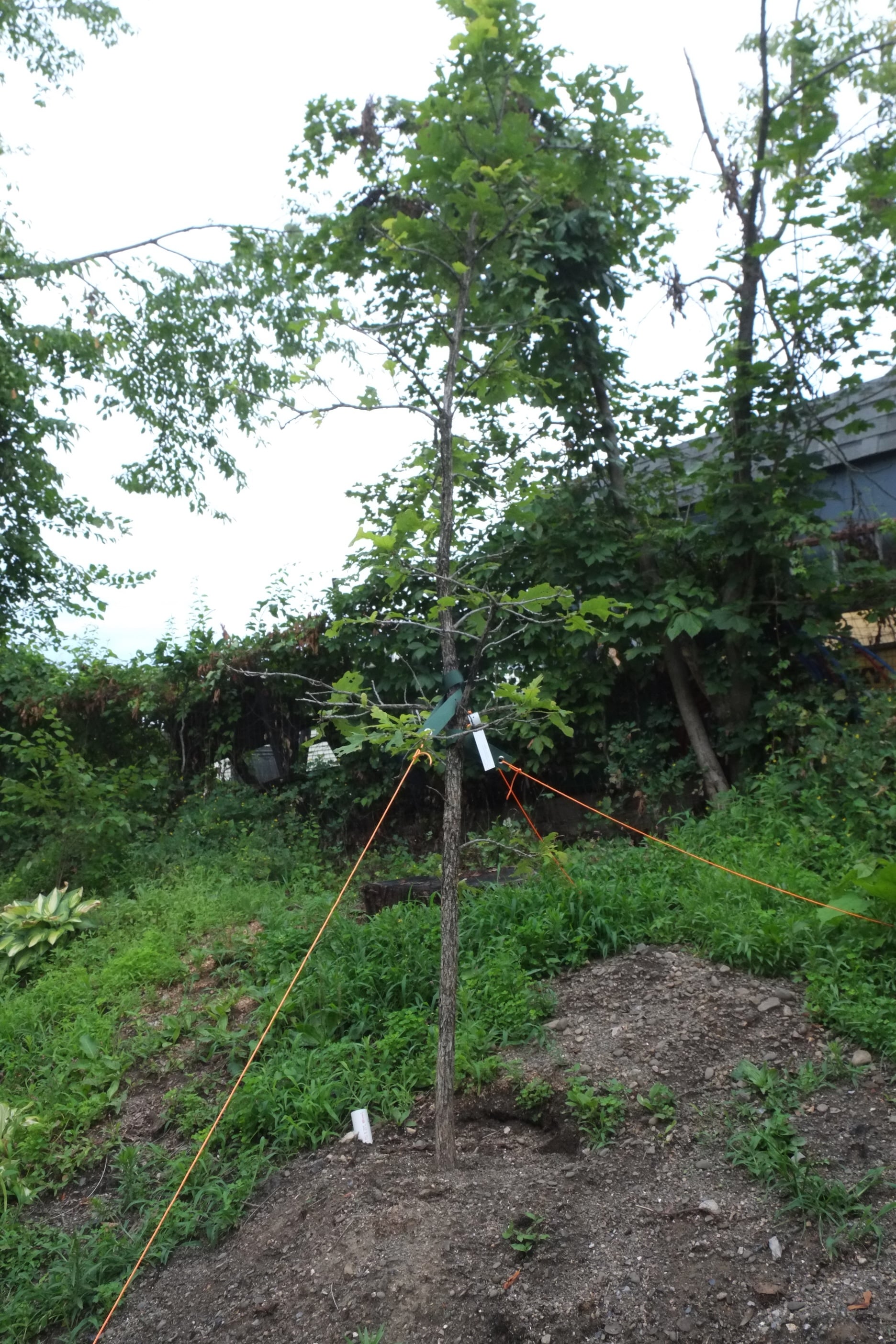
To help compensate for this, we’ve been planting replacement sidewalk trees, yes, they will take years to mature, hence the haste. We planted three trees, a dogwood, a redbud, and a hawthorn (in that order), which are all native NY trees. The hawthorn is a spiky bugger and was donated to us at short notice. The root system had been severely cut back, but we dug a large hole and filled it with high-quality potting soil. That was probably a month ago, and since then, all the leaves have turned brown, which is to be expected; the tree is in shock, and we’ve been experiencing a bad heat wave. We have watered the tree on every non-rain day, so although the tree looks dead, I have confidence that it will spring back next year. It’s a pretty righteous with huge 2″ spikes, so I do hope it recovers. We also planted a second dogwood at the bottom of the garden, which is the last photo.

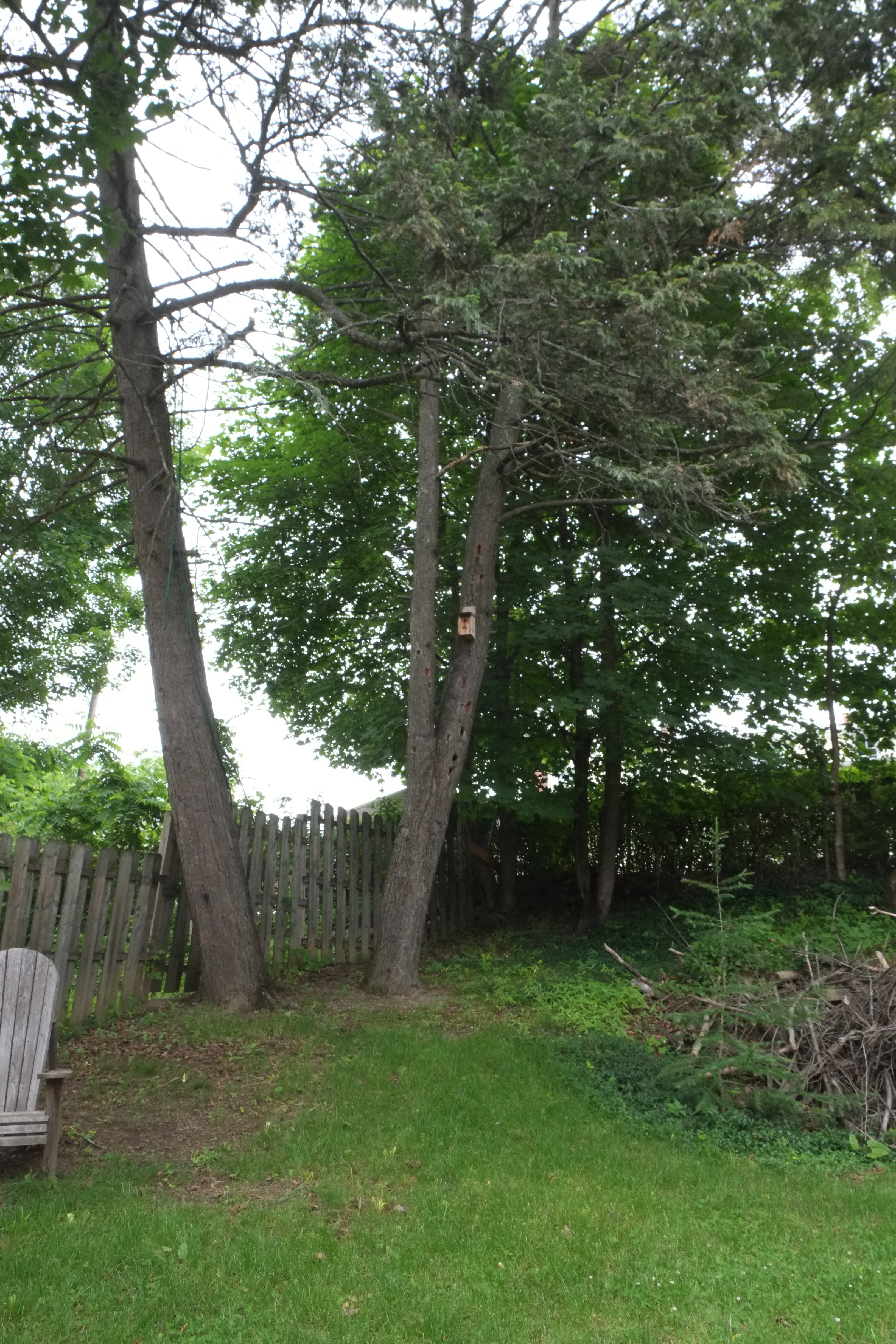
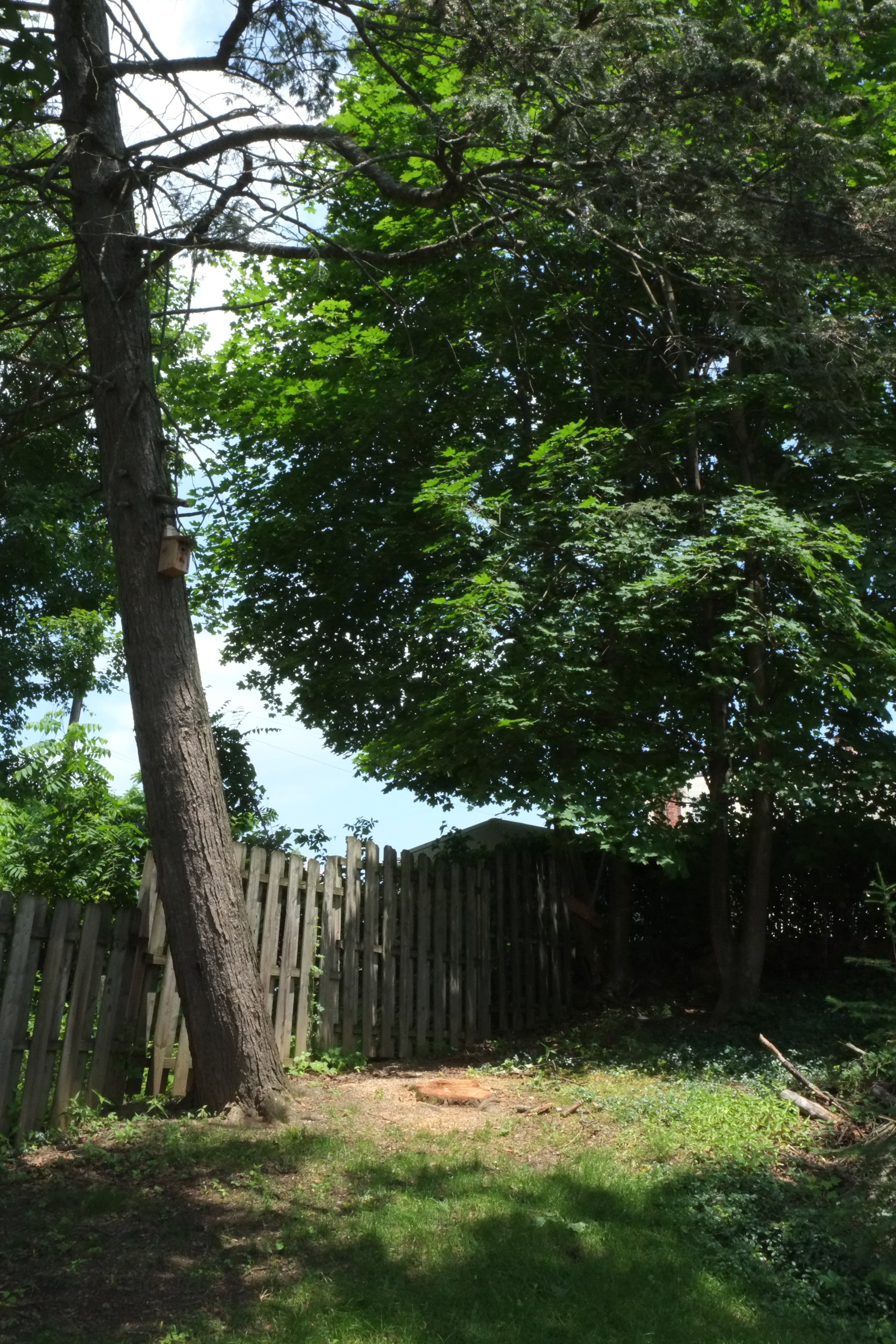
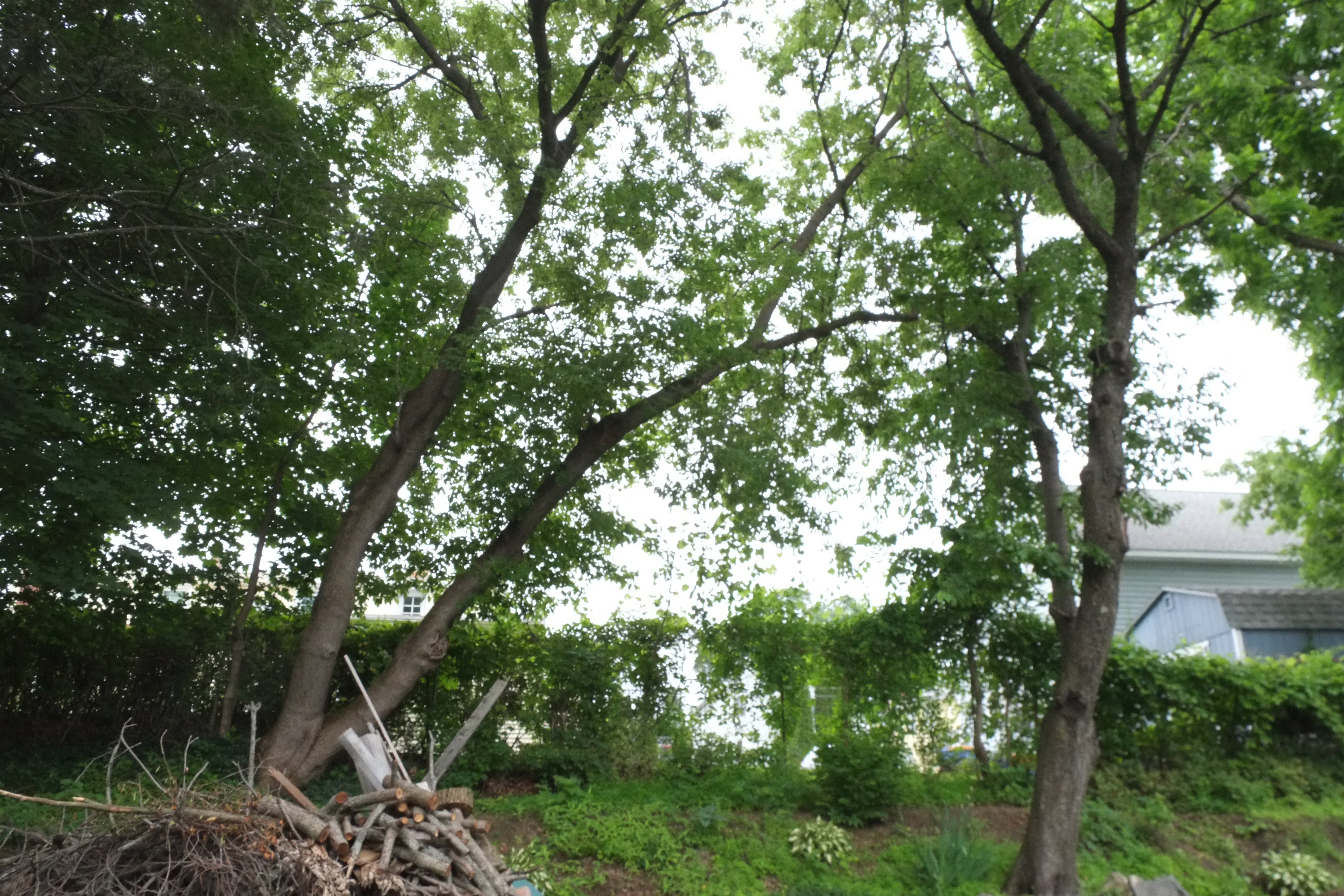
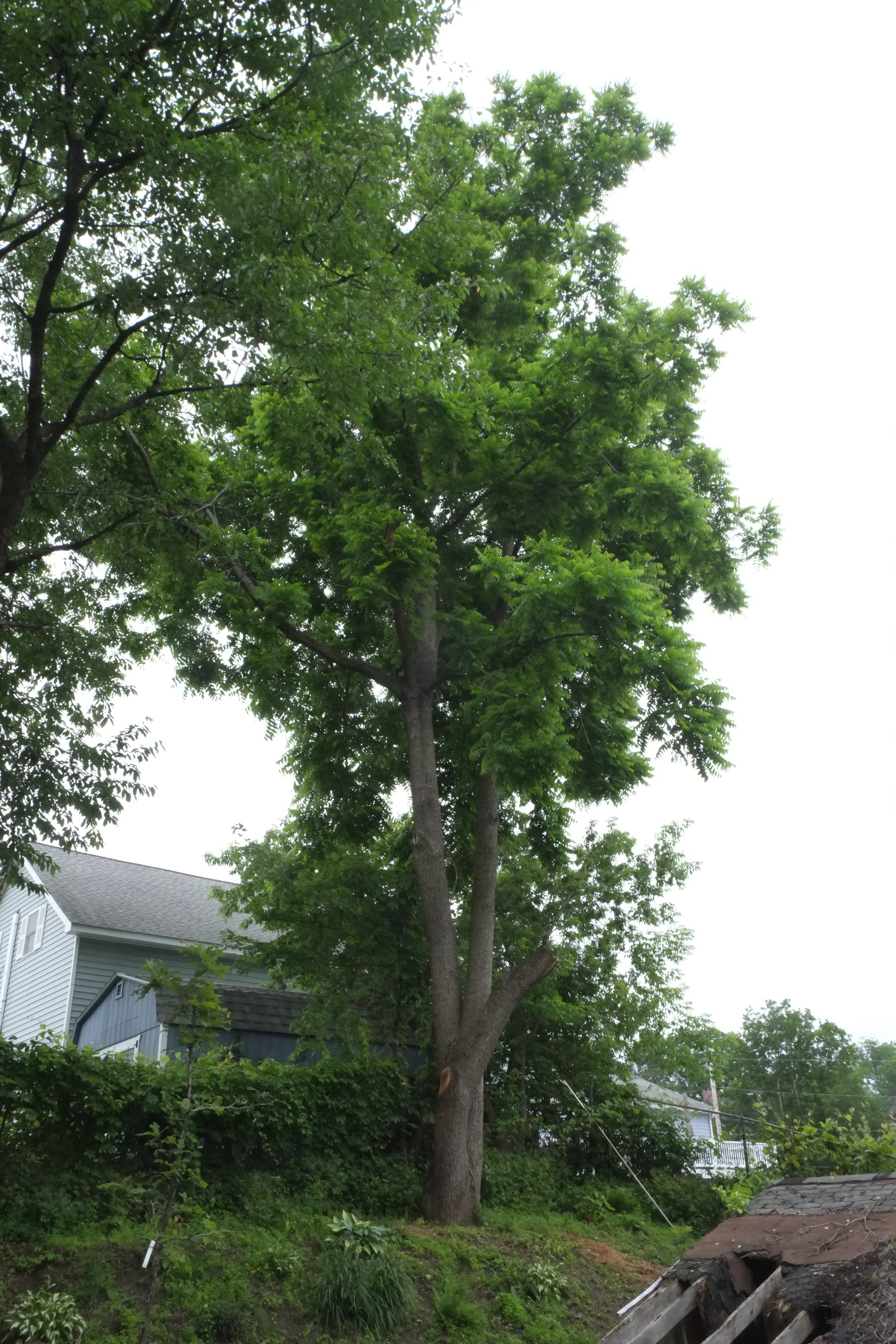
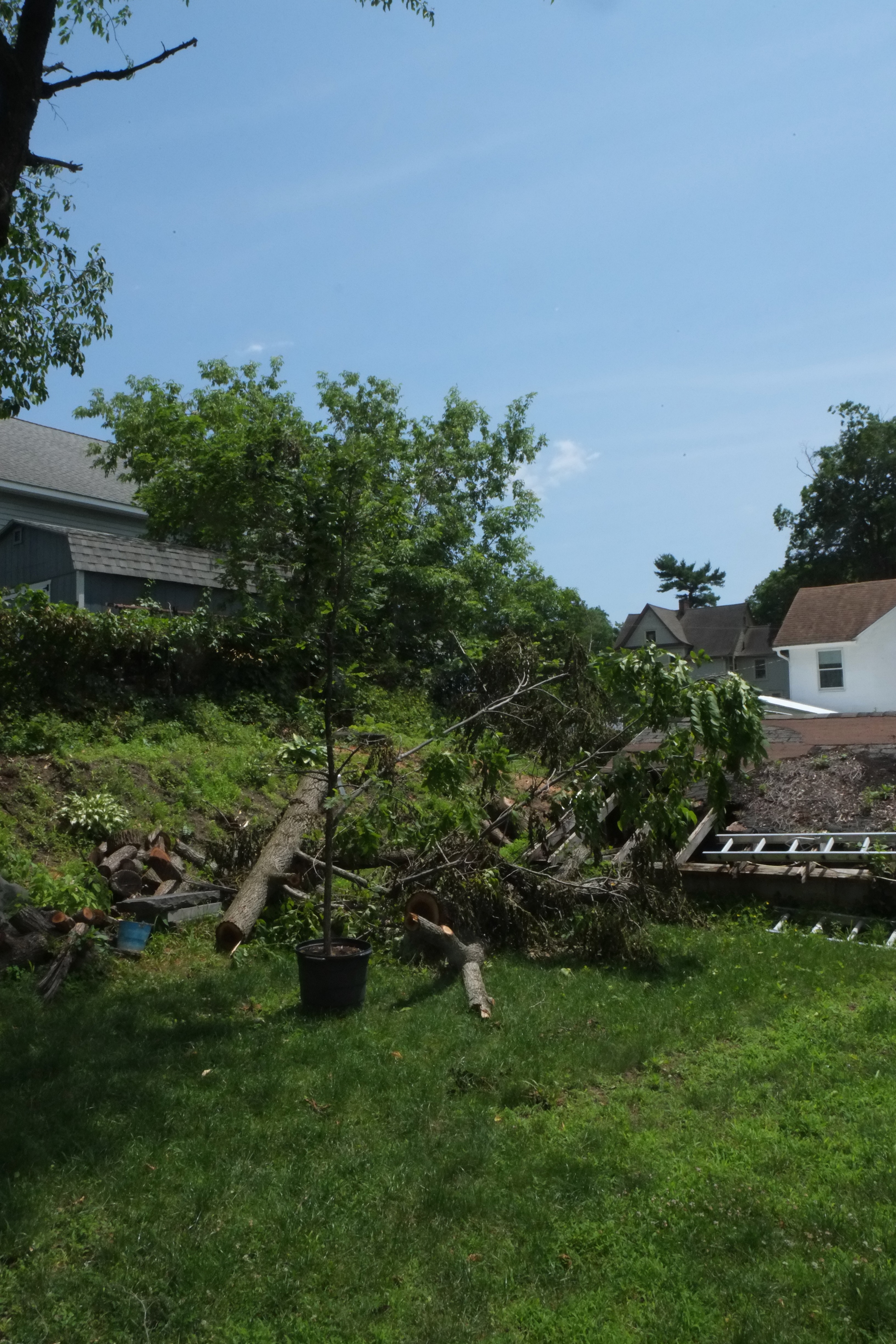
All that said about us being against trees removal, we did get the arborists, Limber Tree Services, to remove our walnut tree as neither of us liked it. At the same time, the arborist trimmed our Box Elder and removed one of our diseased Hemlock trees. I have to say that Limber Tree Services did an excellent job and didn’t trash any of our plants, so thank you very much.

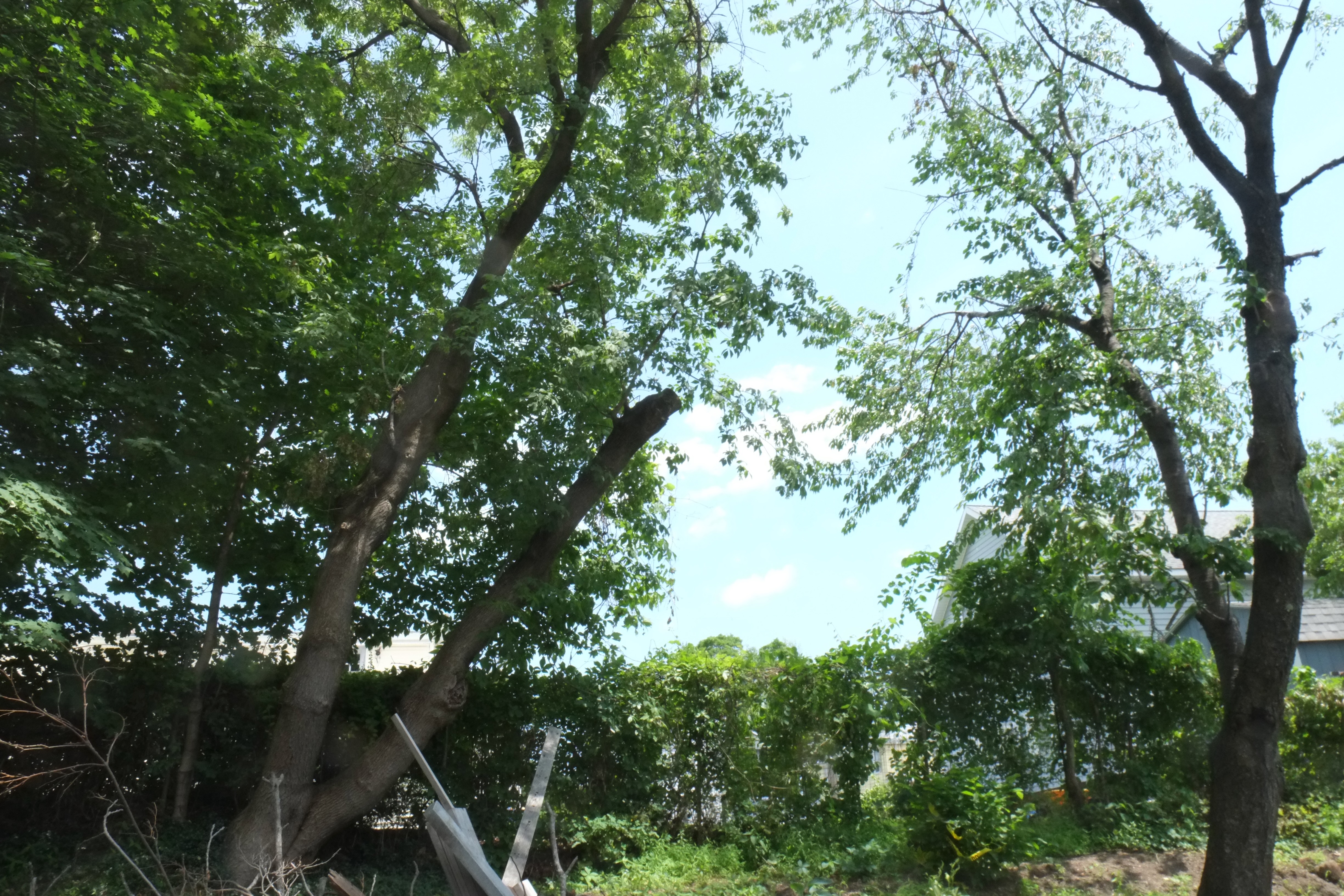
Here are before and after shots.

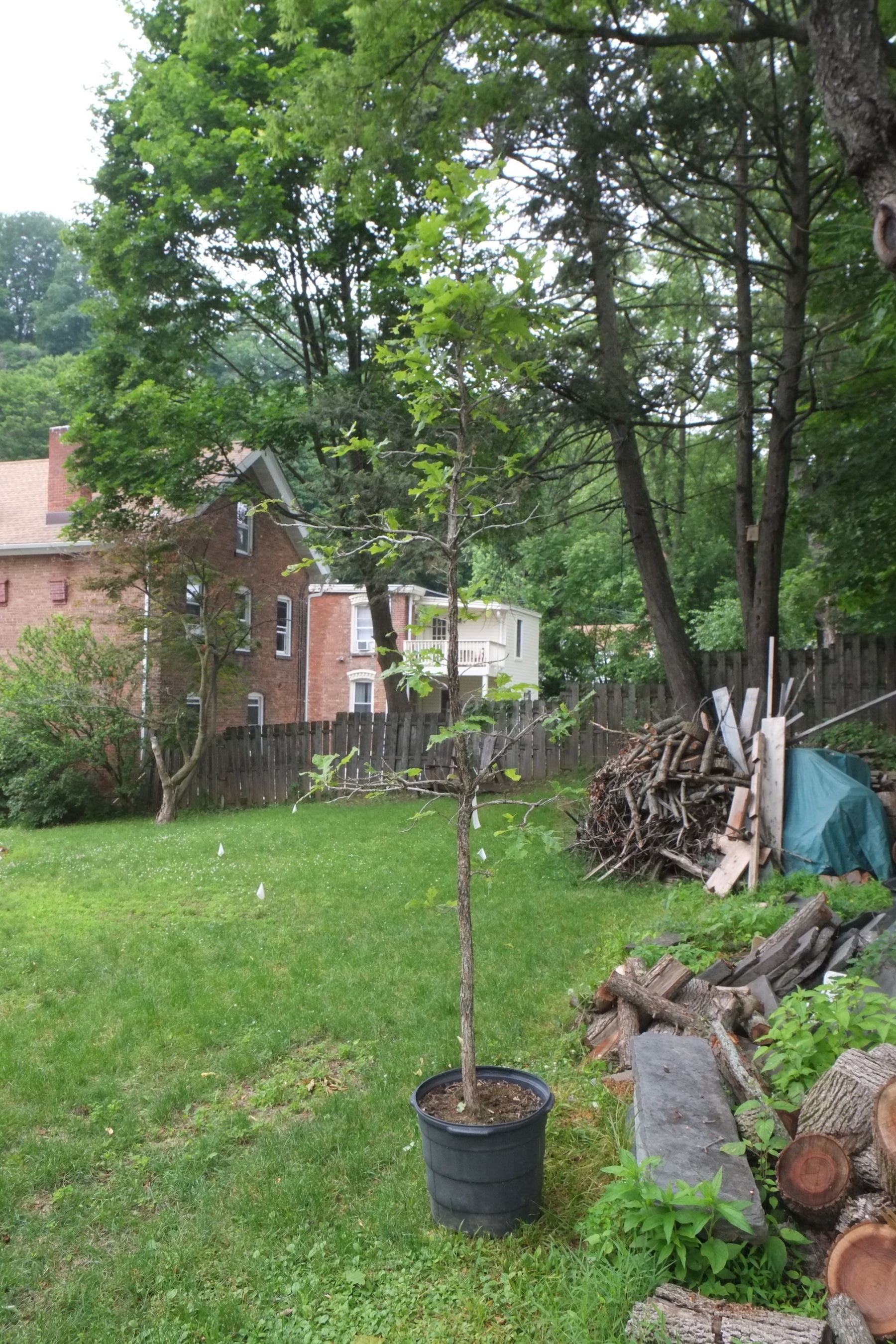
The replacement for the Walnut tree is a Bur oak which should grow into a mighty tree and be around for a few hundred years. It’s probably 5 years old already and could grow up to 1 1/2 feet a year, so hopefully in another 10 years it will start to give us a bit of shade. A big thank you to Catskill Native Nursery who delivered the tree and even carried it to where we wanted to plant it. I highly recommend this nursery.

Elsewhere we’re trying to finish off the parging, testing out some of our concrete floor tiles and we’re collecting bathroom fittings so the plumber will know where to put all the pipe-work. I’ll cover these in the next post.

Welcome to the Bishop

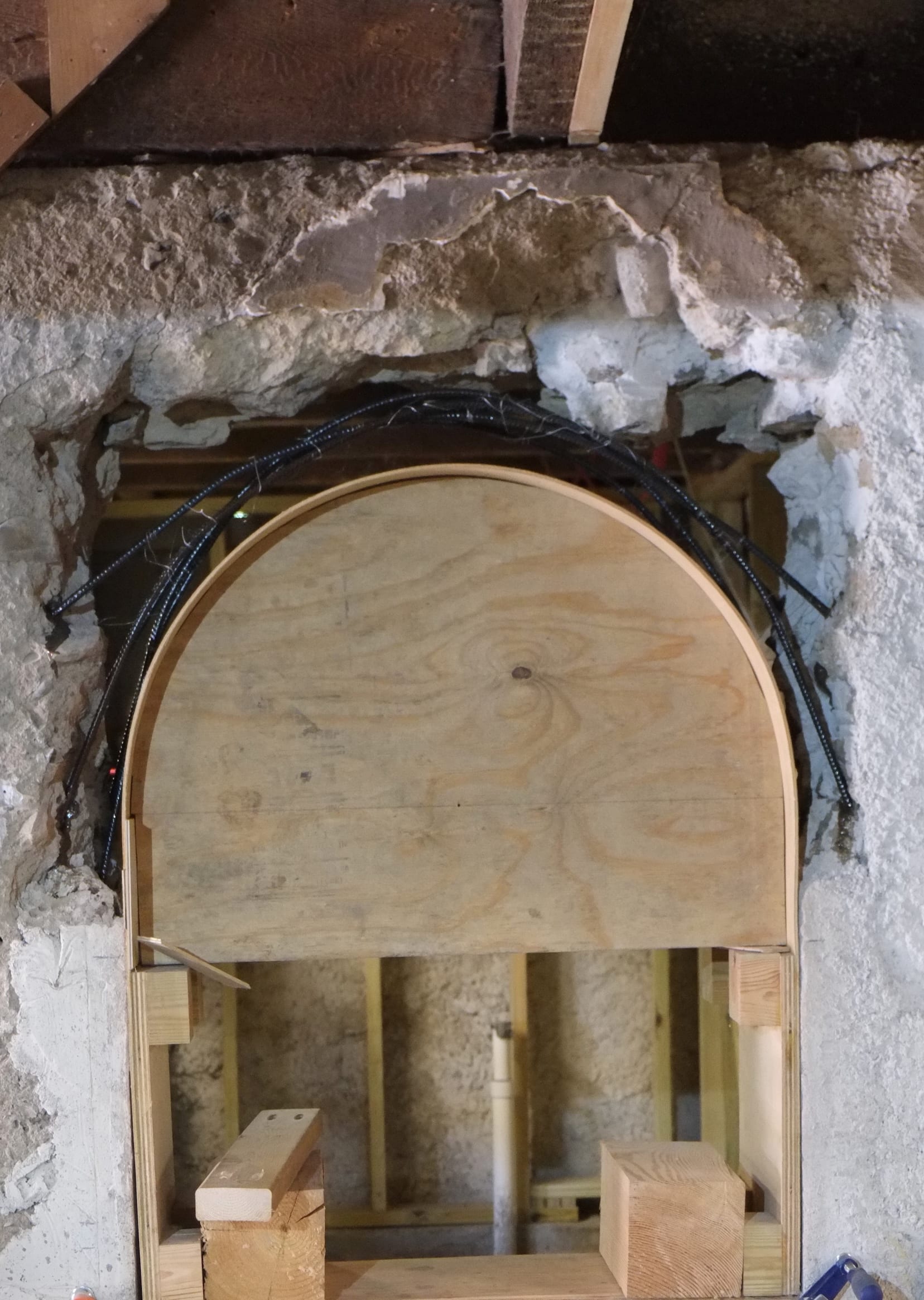
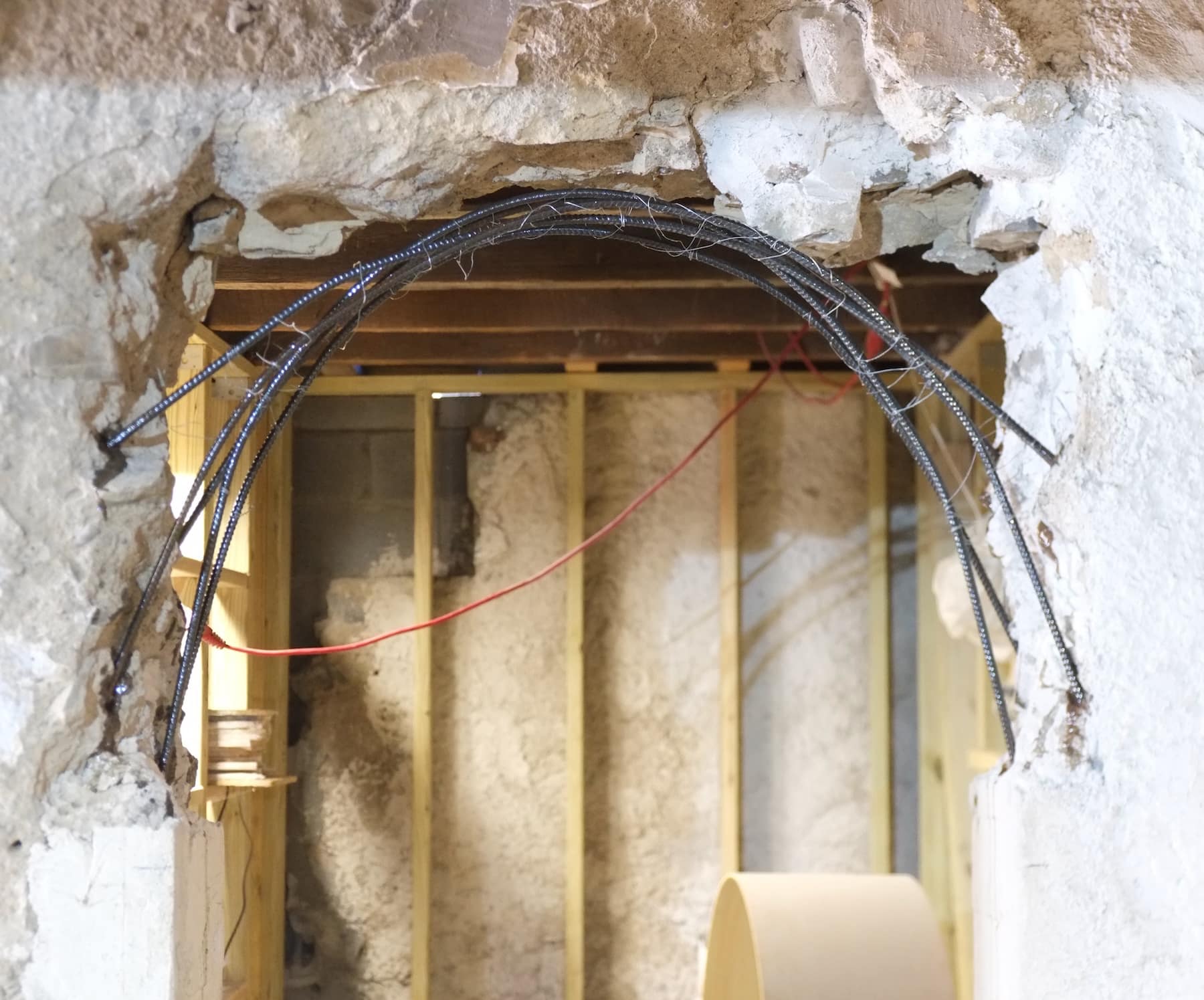
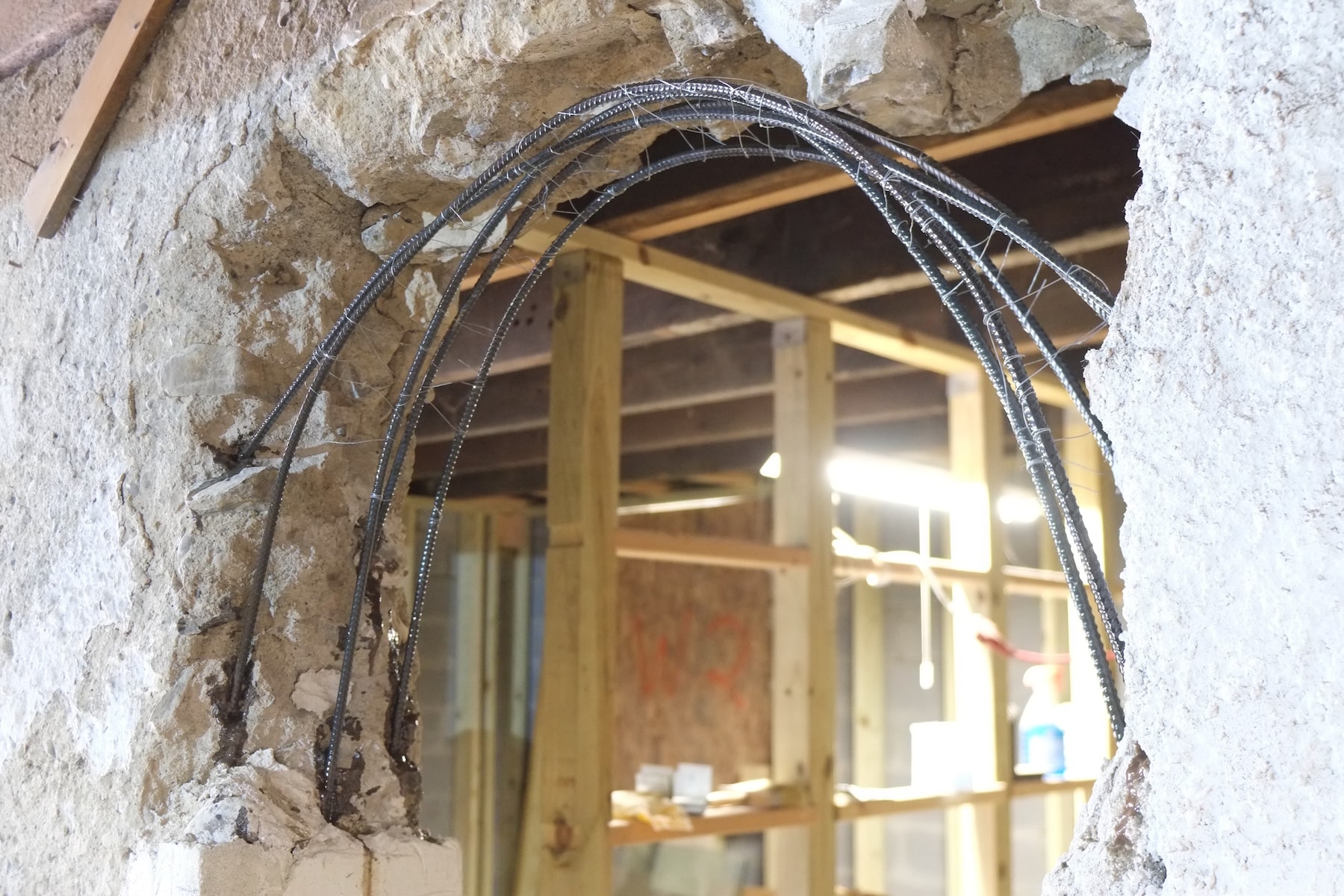
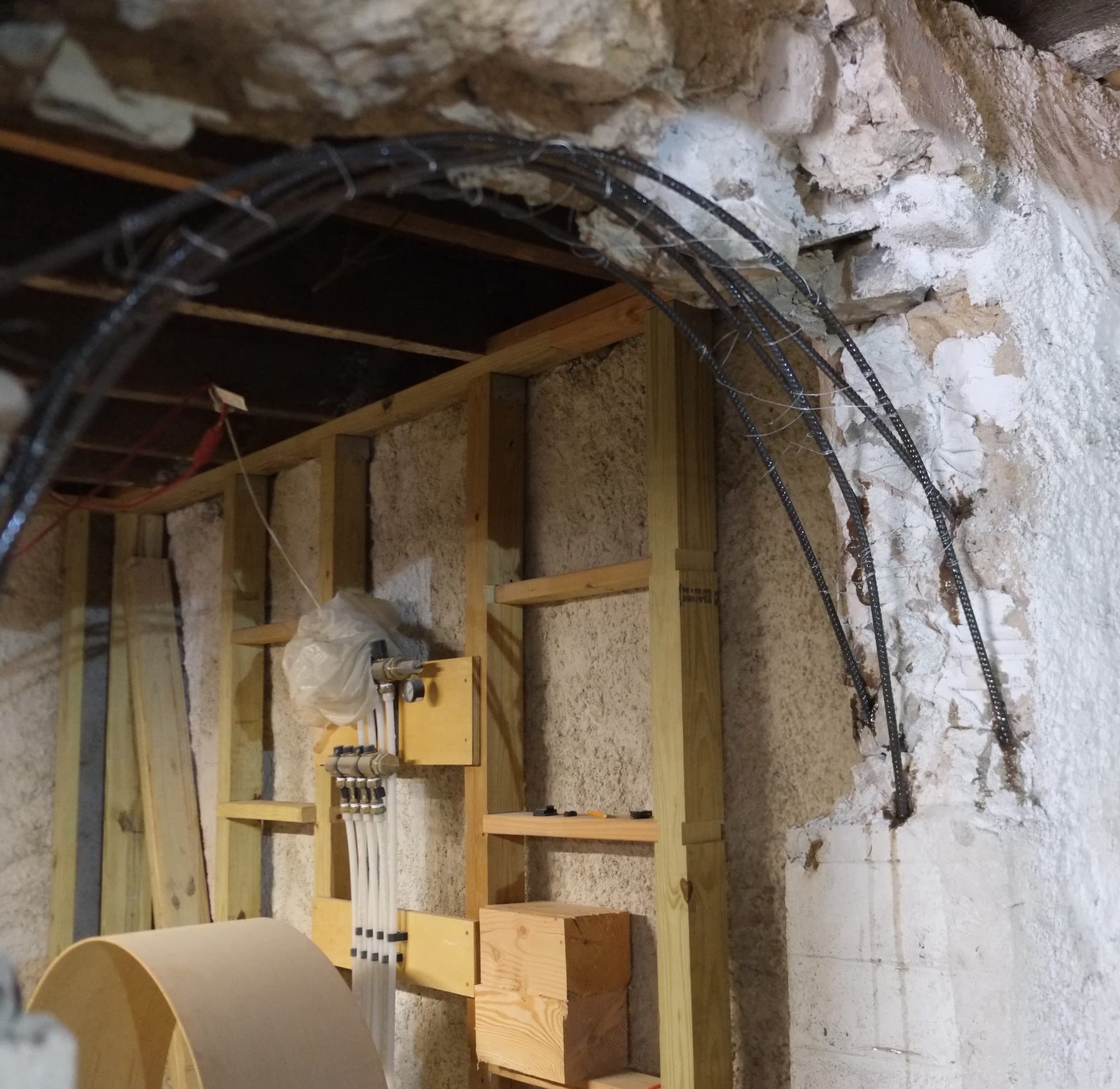
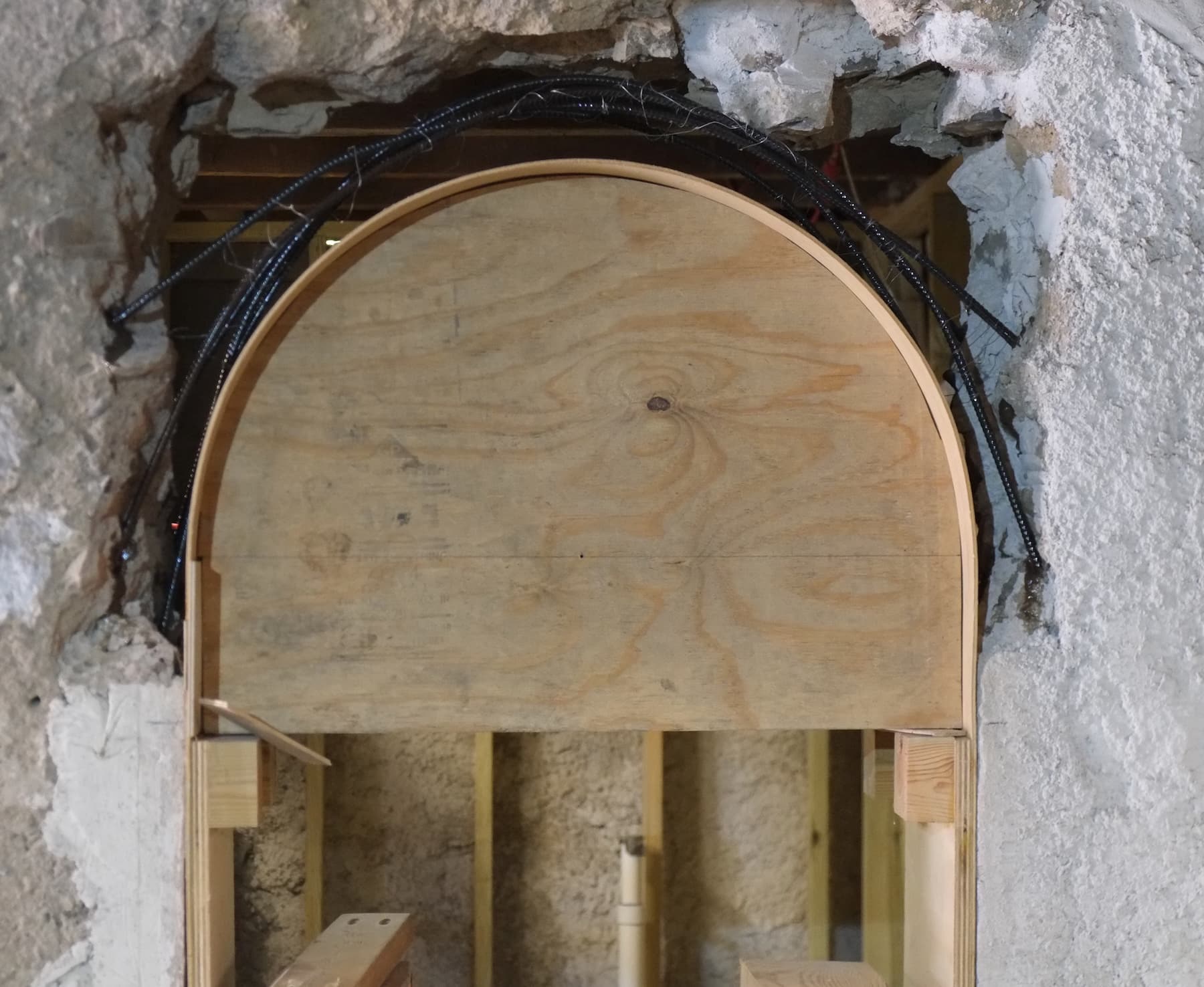
We’ve had a flat arch doorway into our utility room, and it was very dodgy. If it fell, it would have dropped a couple of hundred lbs. of rock and mortar on your head. As we’re are gearing up to get the plumber and electrician in, we thought we’d better fix this.

The picture below is after patching the arch up quite a bit, and even then, I’d never stand under it for long.

As you can see we added a fair amount of rebar and, because lime is caustic, I degreased, de-rusted and coated the rebar in epoxy, yes a pain to do, but this is a house we want to last.

Constructing and setting up the form took a few days, but I think we got it almost right. One thing I wished I had done was to get a better curve when I bent the rebar, if I had, it would have given us an extra 1.5″ in height to the already low doorway. Aimee will be able to pass through it unhindered, and I may scrape my head, but old age and gravity, in time, will allow us free passage with ease 🙂 I will round the corners on both sides so if you do bonk your head, you won’t hit a sharp edge.

Sorry I ran put of disk space. Yes, current results are rough, with low and high spots, but that will be fixed.

We left form and mortar to cure for a week, spraying with water, every day, to help the cure. That done, we applied another scratch coat of mortar which which filled in the majority of the undulations. The following day, it was time to remove the form.

Overall we like the arch, it matches the arch of our front door. Small subtle details like this add up to the overall experience, I think at least.

A few odd jobs

Aimee and I are slowly getting back in the swing of things. In the evenings we’ve been painting and glazing windows and hope to get the first one installed within the next few weeks.

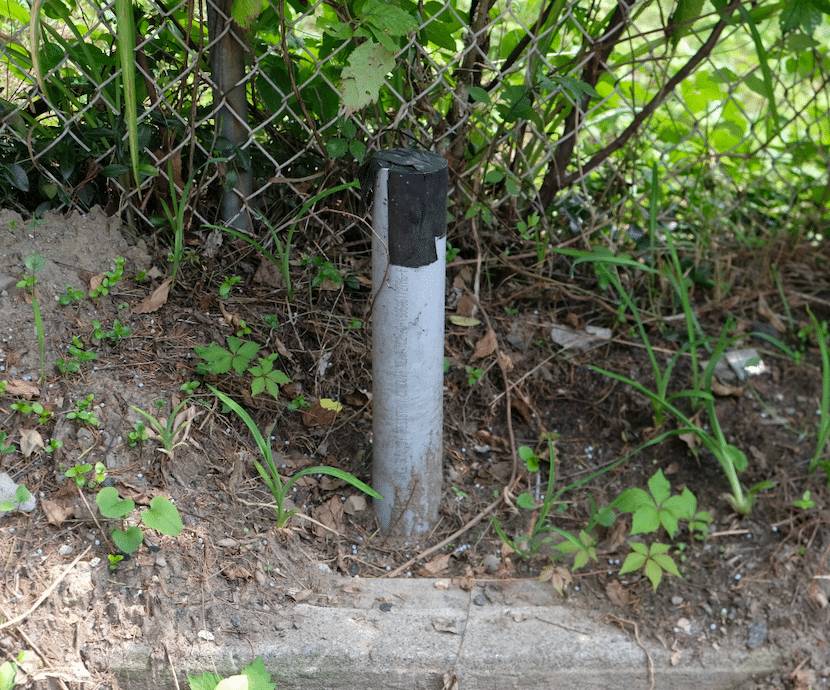
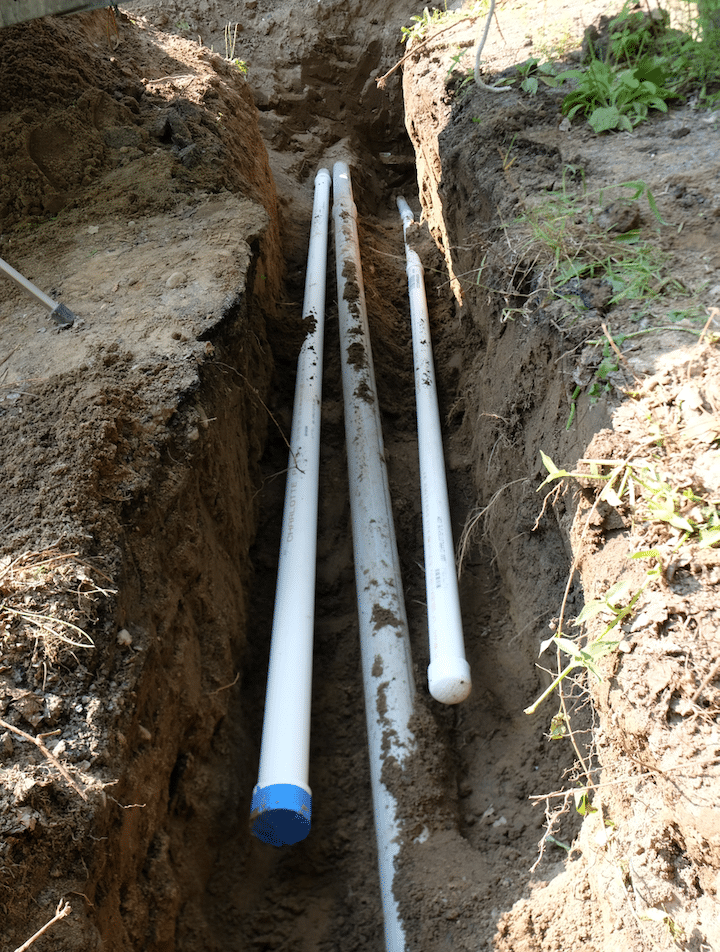
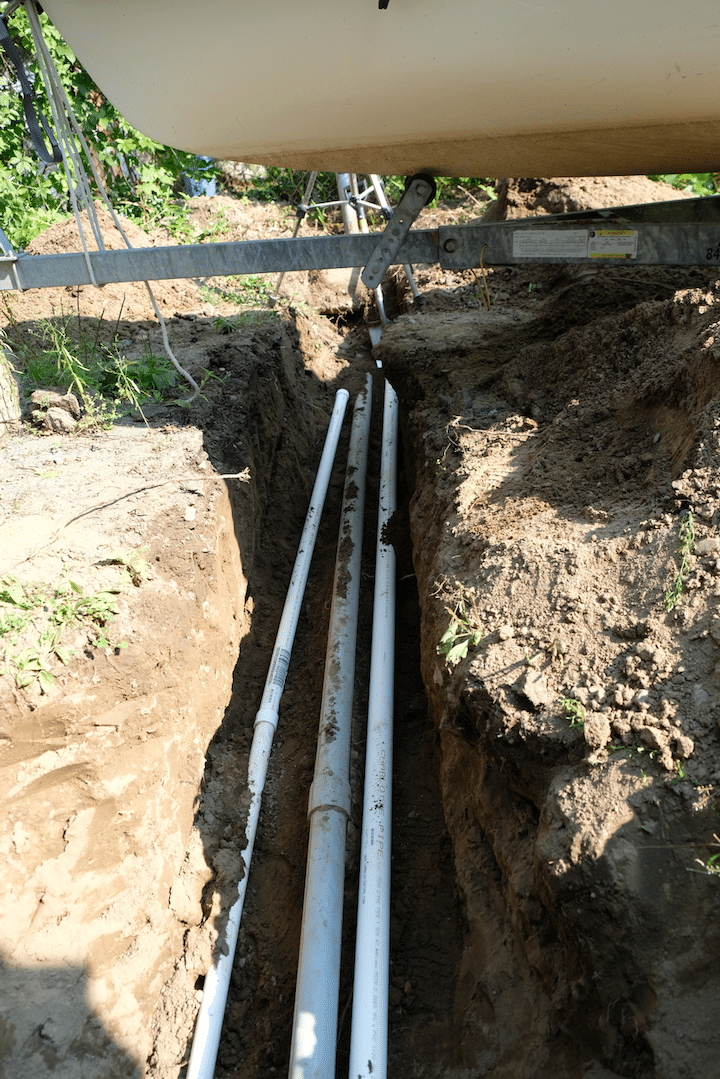
During the last couple of beautiful weekends we’ve been doing a bit of work in the garden and the first task was to complete the foundation drain to the left of our house. Last year we repaired the poor foundation work, done by our previous contractor, patched up the wall and gave it a nice fresh coat of lime plaster, then came porch painting followed by winter, so the trench was left unfilled. Come spring, we did have to dig out a fair bit of soil, that had collapsed into the trench, but now we have the pipe bedded in gravel, wrapped in geo-textile fabric (to keep the dirt out of the gravel) and we had just enough dimple board left over from our previous foundation drain project.

I think the dimple board combined with the foundation drain is a perfect solution for the damp issues we were having. Since we installed this system at the rear of the house, and back filled to a 4′ depth, we have seen absolutely zero damp in that wall, bone dry and I can’t think of any reason why this system should fail, at least not in the next couple of hundred years. Dimple board, geo-textile, gravel, foundation drain is a great solution, which I highly recommend.

Second task was to plant a fruit tree. We both decided we wanted a peach tree. The variety we bought was a cold-hardy Frost peach, and it already has blossoms, which we hope will develop into fruit this year. My Dad, Colin, was a keen gardener, and often wished that he could step out into the garden and pick a fresh peach, alas, the UK is a bit challenging for peach trees, so that never happened. In memory of my Dad, the tree has been named Colin and sits near our Magnolia, Big Nan.

Continuing on the tree theme, we recently heard that our neighbour would like to remove the large maple tree that sits on the edge of our sidewalk/pavement, due to liability issues. I’d rather the tree stays but, I’ll await the verdict of tree surgeon and Kingston Tree Commission.

In my opinion a tree canopy on a street is beautiful, and as it is Gill street doesn’t have many such trees left, we thought we should act, so this weekend we purchased two native dogwood trees, Cornus Florida. It’s an elegant, modest sized tree with an amazing show of flowers and berries for the birds. Our trees are about 5′ high and they grow 1-2′ a year. We placed them so they could be viewed from inside. We think they will look magnificent in years to come.

In our tradition we have named one of the Dogwoods, Mama Dot, our beautiful, 94 old year Gill Street guardian who lives across the street. I will ask permission to post a picture of Mama Dot the next time I see her. By the way, one of previous owners had named a Japanese Maple, “Tiny Tim”, hence the start of the naming tradition. It’s also a good way of specifying areas of the garden, “you know, just around Tiny Tim” etc.

By the way, we do plan to remove a black walnut tree from the rear of our garden, replacing it, possibly with an oak, so there will still be food for critters.

Glazing is hard!

The other day, we glazed our first window pane, and boy was it hard. I’ve watched plenty of videos on the subject, and yes, it looks hard, but I wasn’t expecting it to be this hard.

In the videos, the putty seemed like plasticine or play-doh, but out of the tub it was very sticky with hard lumps in it. I tried to break the lumps up by hand, but it was taking ages and getting very messy, so I checked online, and people suggested microwaving it, which did the trick. Then it seemed even stickier and I couldn’t get it off my hands. Luckily I had some chalk powder at hand (which is one of the ingredients of putty), and that got me to the consistency I wanted.

First task was to get the glass bedded down onto the rebate, to ensure a good fit and seal. A bead of putty is added to the rebate, the glass is inserted and pressed down to squeeze out any excess, which is trimmed off with my fancy putty knife. After a dusting with pumice powder, to remove any excess oil from the glass, it did start to look okay.

Back to the glass side again, I made a mess of applying the bead of putty, but I know this will clean up. The problem I had was having was getting a nice chamfer on the putty, which seems to come down to getting the right pressure and angle of the knife. The corners took me a while but eventually I had it complete.

On the videos, the experts glaze a pane in about 10 minutes, it took me well over an hour but in the end it looked pretty decent. As recommended when using linseed oil, putty and paint, I immediately dusted the putty with chalk and then painted it. You’ll see that I painted on the glass as well, this is to give the putty a good seal against the glass, with any excess removed with a razor blade once the paint has cured.

Overall I think I scored a ‘C’ on my first attempt and no doubt I’ll get better and faster,
though today I couldn’t get the chamfer correct at all and had to scrape off all the putty, very frustrating. Not sure I like glazing.

Welcome to the Vibra-Tron©

As I’ve had some interest in the concrete tiles we’ve been making, I made a small video explaining the process, it’s rather long and lo-fi but it covers all aspects of making a tile.

Star of the show in my eyes is the Vibra-Tron©, which isn’t at all necessary but it’s fun and does make the make the process slightly faster.

The Vibra-Tron© is driven by a vibration motor we bought online and the adjustable feet came from FireflyInnovations.

Moulds and pigments have links in this previous post.

We’re also considering replacing the cream crosses with a pale green for the bathroom, but we’ll see.

Currently, we’ve made about 70 tiles.